

Introduction
For more than fifteen years, the international development financing system functioned on a recognisable architecture. Western donor governments, led by the United States, Germany, the United Kingdom, France, and Japan, channelled official development assistance through bilateral agencies, multilateral funds, and specialised implementing partners. Together they built an ecosystem of health clinics, schools, agricultural extension services, governance reform programmes, and emergency humanitarian responses that reached hundreds of millions of people across sub-Saharan Africa, South and Southeast Asia, and fragile states worldwide.
The scale was significant. According to the OECD Development Assistance Committee (DAC), net ODA from DAC members grew from approximately $128 billion in 2010 to $226 billion by 2023, an increase of 77% in nominal terms. Between 2019 and 2023 alone, ODA rose 32.7% in real terms, driven partly by the COVID-19 response and partly by rising humanitarian demands from conflicts in Syria, Yemen, and the Sahel.
The system was not perfect. Critics consistently pointed to donor coordination failures, conditionality that constrained recipient-country policy space, high administrative costs, and the tendency for aid to follow donor strategic interests rather than recipient-country priorities. The Paris Declaration on Aid Effectiveness (2005) and successive High-Level Forums acknowledged these weaknesses. Progress was uneven. But the system delivered measurable results: health outcomes improved, primary school enrolment rose, and several countries graduated from aid dependence entirely.
The Architecture by Donor
The United States Agency for International Development (USAID) was the world's largest bilateral donor, disbursing approximately $44 billion in 2023 across more than 6,000 active programmes in over 60 countries. Priority sectors included global health, with flagship programmes in HIV/AIDS (PEPFAR), malaria, tuberculosis, and maternal and child health, humanitarian response, food security (Feed the Future), democracy and governance, and economic development. USAID operated through a vast implementing partner network of NGOs, contractors, and multilateral agencies. The Center for Global Development estimates that USAID's health programmes alone provided antiretroviral treatment to 20 million people globally and supported over 50,000 health workers across sub-Saharan Africa.
Germany's bilateral ODA operated primarily through the Deutsche Gesellschaft für Internationale Zusammenarbeit (GIZ) and the KfW Development Bank. In 2023, GIZ reported a business volume of EUR 3.96 billion operating across approximately 120 countries, with Africa receiving EUR 1.5 billion, 38% of the total. German ODA concentrated on sustainable economic development, rural development, water and sanitation, governance, and biodiversity. Germany also led contributions to several EU-managed development funds and was the second-largest contributor to the World Bank's concessional lending arm, IDA.
The United Kingdom's Foreign, Commonwealth and Development Office (FCDO) managed a programme budget that peaked at £9.3 billion per year. Key programme areas included girls' education (Girls' Education Challenge), climate adaptation, health systems strengthening, and humanitarian response. The UK was a leading funder of multilateral institutions including the Global Fund to Fight AIDS, Tuberculosis and Malaria, Gavi (the Vaccine Alliance), and the CGIAR agricultural research network. The UK also pioneered development finance through British International Investment, its DFI, which committed over £1 billion annually to private sector development across Africa and South Asia.CGD analysis places the UK among the five most impactful bilateral donors per pound spent.
The European Union operated both a bilateral development programme (through the European Commission's DG DEVCO, now DG INTPA) and substantial multilateral contributions. The EU's development budget exceeded €15 billion annually before the current retrenchment, with geographic focus on the African, Caribbean and Pacific group of states under successive Cotonou and Samoa Partnership agreements. The EU's Global Gateway initiative announced in 2021 as a €300 billion package for global infrastructure investment represented a shift toward leveraging private capital, though implementation remained well behind commitment levels.
Norway, Finland, Sweden, and Denmark consistently allocated 0.7% or more of gross national income to ODA — meeting the UN target that most OECD donors have never achieved. Norway reached 1.03% GNI in 2024. These Nordic donors prioritised reproductive health and rights, gender equality, climate adaptation, and anti-corruption programming, often channelling funds through multilateral organisations and civil society organisations that bilateral agencies could not or would not fund directly.
Recipient Countries and Sectors
Aid flows were concentrated geographically and sectorally. Sub-Saharan Africa consistently received the largest regional share of global ODA $73.6 billion in 2023, representing over 36% of total DAC ODA. Within Africa, the largest recipient countries included Ethiopia, the DRC, Nigeria, Tanzania, Kenya, Uganda, Mozambique, Somalia, and South Sudan, all characterised by high poverty rates, weak government revenue, and significant humanitarian pressures.
Source: OECD DAC Creditor Reporting System (CRS), 2023 provisional data.
Sectorally, global health absorbed the largest share of bilateral ODA in most years roughly 20–25% of total flows followed by humanitarian aid, education, water and sanitation, agriculture and rural development, and governance and civil society. The health share reflected the impact of PEPFAR (the US President's Emergency Plan for AIDS Relief), the Global Fund, and Gavi, all of which mobilised exceptional resources at a scale that distorted the overall picture of sectoral allocation.
Between 2010 and 2023, ODA grew 77% in nominal terms. It took one year to erase over half that growth.
The World Bank Group served as the multilateral counterpart to bilateral flows. In financial year 2024, the World Bank disbursed $89 billion across all lending windows IDA ($28.2 billion in concessional lending to the poorest countries), IBRD ($33.5 billion in loans to middle-income countries), and IFC private sector operations. This represented a near-doubling from FY2020 levels of $54.4 billion and reflected the Bank's response to overlapping crises from COVID-19, climate shocks, and the food and energy price spikes of 2022–23.
The Verified Impact Record
The case for ODA has always had to contend with a contested empirical record. Aid sceptics from Peter Bauer in the 1970s to Dambisa Moyo in 2009 argued that aid created dependency, undermined domestic accountability, and distorted incentives. Academic economists produced hundreds of studies with conflicting findings on the relationship between aid and economic growth. This debate, while important, often overshadowed a clearer and more robust body of evidence: the impact of targeted sector-specific ODA on measurable human development outcomes.
The most comprehensive recent assessment comes from the ISGlobal/Lancet study published in 2024, which tracked ODA flows against health outcomes across 93 low- and middle-income countries between 2002 and 2021. The findings are unambiguous: high levels of health ODA were associated with a 39% reduction in under-5 child mortality, a 70% reduction in HIV/AIDS mortality, a 56% reduction in malaria deaths, and a 39% reduction in tuberculosis deaths. These are not marginal effects. They represent millions of lives saved per decade of sustained funding.
High ODA was associated with a 70% reduction in HIV/AIDS mortality and a 39% reduction in under-5 deaths, effects measured across 93 countries over 19 years.
The mechanisms are well-documented. PEPFAR, launched in 2003, built or supported over 3,000 health facilities across fifteen African countries, trained 290,000 health workers, and placed 20 million people on life-saving antiretroviral treatment. By its own monitoring data, PEPFAR prevented an estimated 25 million deaths between 2003 and 2022. The Global Fund mobilised $65 billion over two decades to fight AIDS, TB, and malaria saving an estimated 65 million lives by the Fund's own calculations.
In education, the UK's Girls' Education Challenge supported over 1.5 million girls to attend and stay in school across twelve countries. USAID's Feed the Future programme reached 28 million smallholder farmers across 24 countries, contributing to measured reductions in stunting and food insecurity in several recipient countries. GIZ's water and sanitation programmes improved water access for an estimated 12 million people annually in sub-Saharan Africa and Asia.
Governance and institutional development outcomes are harder to quantify but no less important. Multi-donor programmes supported electoral reforms in Ghana, Liberia, Sierra Leone, and Kenya; anti-corruption institutional development in Rwanda and Botswana; public financial management reforms in Tanzania and Ethiopia; and civil registration infrastructure across the Sahel. The measurement challenge does not mean these investments were without value, it means that value is often only visible in the counterfactual.
Aid and Economic Transformation
The relationship between ODA and economic growth remains genuinely complex. Aid-dependent economies can face 'Dutch disease' effects, an appreciation of the exchange rate that undermines export competitiveness. Budget support that substitutes for domestic revenue mobilisation can crowd out the accountability relationships between governments and citizens that drive good governance over the long run. These are real risks, and well-designed aid programmes try to mitigate them.
But the evidence also shows that ODA, properly designed, can accelerate structural transformation. Infrastructure funded by ODA (roads, ports, energy, digital connectivity) lowers the costs of doing business and integrates domestic producers into regional and global markets. Health and education ODA builds the human capital that is the most reliable predictor of sustained growth. And technical assistance, when demand-driven and country-owned, can build institutional capacity that outlasts the individual programme.
Several countries that were substantial ODA recipients in the 1990s and 2000s have graduated out of aid dependence: Botswana, Mauritius, Thailand, and more recently Rwanda and Vietnam. Aid was not the only factor governance quality, resource endowments, regional integration, and investment climate all mattered. But the trajectory from UNCTAD's World Investment Report 2024 shows that countries with sustained ODA above 4% of GNI for ten or more years were significantly more likely to achieve middle-income status over a thirty-year horizon than comparable countries without sustained support.
The Situation Donors Are Now In: Geopolitics, Rearmament, and Structural Pressure
The retrenchment of ODA in 2025 was not accidental. It reflects a convergence of geopolitical pressures, domestic fiscal constraints, and a deliberate political reassessment of the value of international development assistance in several major donor countries. To understand what is happening, and whether it is temporary or structural, it is necessary to examine the forces driving each of the major donor actors.
The Return of Great-Power Competition and Rearmament
Global military expenditure reached $2,718 billion in 2024, a 9.4% real-terms increase and the steepest annual rise since 1988. In 2025, it rose further to $2,887 billion, according to SIPRI's latest global data. This represents a 37% increase since 2015, when the SDGs were adopted and ODA commitments were made, a period in which development finance was supposed to be scaling up, not being displaced.
European defence spending has been the most dramatic regional shift. NATO's European members increased their collective defence budgets by 102% over the period 2016–2025, responding to Russia's invasion of Ukraine in 2022 and the subsequent consensus that European security architecture required urgent recapitalisation. At the 2026 NATO summit, all 32 members met the 2% of GDP defence spending target for the first time in the alliance's history a target that had been aspirational for most of the post-Cold War period.
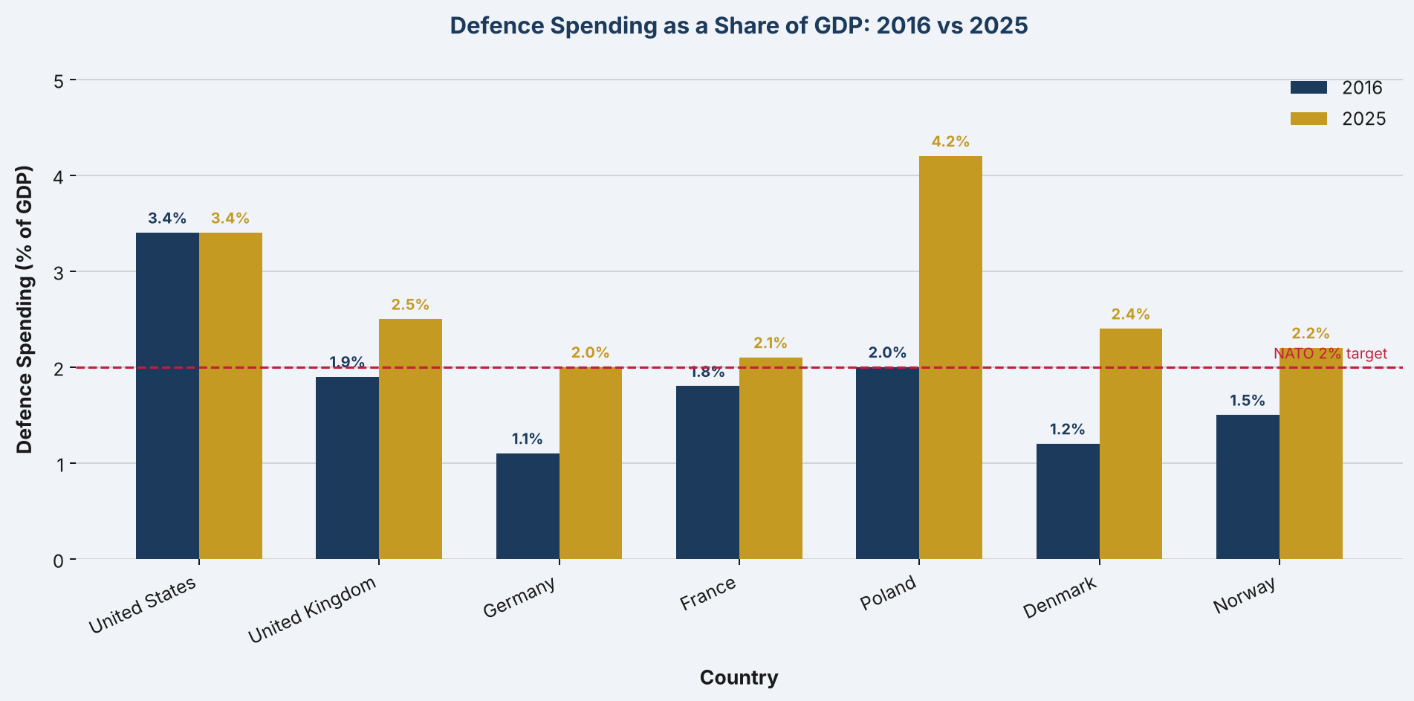
Source: SIPRI Military Expenditure Database 2025; OECD DAC Preliminary ODA Figures 2025.
The connection between defence and development budgets was made explicit in the United Kingdom. In announcing the increase in defence spending to 2.5% of GDP, the government simultaneously cut the ODA budget from 0.5% to 0.3% of gross national income, a reduction of approximately £6 billion annually. As the FCDO announcement stated: the savings from development are being redirected to security. This is the arithmetic of rearmament: in countries where total discretionary spending is constrained, the rise of one line must be funded by the fall of another.
The United States: A Different Kind of Cut
The American case is distinct from the European rearmament story. US defence spending has remained broadly stable as a share of GDP. What changed in early 2025 was a wholesale political reassessment of foreign assistance, implemented through executive action that bypassed the normal budget process.
Beginning in January 2025, the new US administration issued a series of executive orders and directives that froze, suspended, or terminated USAID programmes across all regions. Devex's timeline of the freeze documents how, within weeks, over 90% of USAID's implementing partner contracts were subject to stop-work orders. By May 2025, only 891 of 6,256 active programmes remained operational, a 14% continuation rate. The cuts were not targeted at low-performing programmes or designed around an alternative development theory. They were across-the-board and ideologically driven.
The sectoral impact was catastrophic in its specificity. Reproductive health and family planning funding fell by 92%. Maternal and child health by 89%. HIV/AIDS programmes, including PEPFAR, which had for two decades enjoyed bipartisan support, were reduced by 69%. Malaria programmes fell by 68%. Democracy and governance support, long a pillar of American soft power, was cut by 96–99%.
Reproductive health funding fell 92%. HIV/AIDS by 69%. Democracy and governance support by 96–99%. These were not budget adjustments they were programme eliminations.
The US shift represented something beyond fiscal restraint. It signalled a withdrawal of the United States from a role lead donor and architect of the multilateral development system that it had held since the Marshall Plan. Whether this withdrawal is permanent or contingent on electoral politics in 2028 is unknown. But the institutional damage, to implementing partners, to government counterpart agencies, to the trust-based relationships that take years to build and months to destroy, will take years to reverse regardless of political direction.
The Funding Cliff: Cuts, Country by Country, Sector by Sector
Two layers of data now define the scale of the collapse. The OECD preliminary ODA statistics for 2025 (April 2026) confirmed that total DAC ODA fell to $174.3 billion down 23.1% from $226 billion in 2024, the largest single-year decline in the history of recorded ODA. For 2026, individual donor governments have published confirmed budget figures, legislated by parliament or signed into law, that make the continuing direction unmistakable: the United States enacted a $50 billion foreign assistance envelope (down $9.3 billion from current levels); Germany's parliament passed a BMZ development budget of €10.05 billion (its fifth consecutive annual cut, down from €12.16 billion in 2023); France's 2026 Finance Bill confirmed a €700 million (16%) cut to its ODA budget line. The OECD's June 2026 projections compiled from these national budgets place total DAC ODA at USD 152 billion for 2026, a further 6.9% decline. Taken together, 2025 and 2026 represent a cumulative loss of USD 74 billion in annual ODA within two years, aid flows not deferred, but gone.
Donor-Level Breakdown
Sources: OECD DAC 2025 Preliminary Statistics; UK Statistics on International Development: Final ODA Spend 2025; Germany 2026 Federal Budget (Donortracker); France 2026 Finance Bill ODA cut (Donortracker); US FY2026 Foreign Assistance Appropriations Act (WOLA); OECD ODA Projections for 2026 and the Near-Term. † Total DAC ODA for 2026 is OECD-compiled from national budgets; final figures publish April 2027.
Regional Impact: Africa Hardest Hit
Africa, as the largest recipient region, absorbed the greatest absolute losses. The Mo Ibrahim Foundation's analysis of the 2025 data estimates bilateral ODA to Africa fell to $29.0 billion, down 23.9% from $38.1 billion in 2024. With donor governments having now confirmed their 2026 budgets, the OECD's compiled data shows this is not the floor: bilateral ODA to sub-Saharan Africa is on course to fall a further 11.6% in 2026, with total support (bilateral plus multilateral) falling 9.8%. The cumulative bilateral decline for sub-Saharan Africa across 2024 to 2026 reaches 37.2%, a loss of USD 11.8 billion in annual flows within two years.
For least developed countries (LDCs), bilateral ODA fell 25.8% in 2025 and is on course to fall a further 10.9% in 2026, a cumulative reduction of 34.5% (USD 10.5 billion). The FCDO's July 2026 country allocation data published in the FCDO Annual Report, provides a concrete illustration of what this means in practice: Malawi and Mozambique face direct UK funding cuts of 90% from pre-cut levels; Somalia's direct support falls 49%; South Sudan's 46%. For countries where ODA represents more than 20% of national budgets, these are not line-item reductions they are structural fiscal crises.
Sources: Bond.org.uk ODA data analysis; Devex country reporting; Mo Ibrahim Foundation 2025; CGD analysis; OECD ODA Projections for 2026 and the Near-Term (June 2026) for 2026 country-level health figures.
Sector-Level Collapse
The sectoral distribution of cuts reveals what donors have chosen to abandon. In 2025, humanitarian aid fell 35.8% the largest absolute reduction on record. Compiled from confirmed 2026 donor budgets, the OECD's June 2026 data shows the 2024–2026 cumulative picture is far worse: humanitarian assistance falls 40.3% (USD 9.3 billion); health ODA 29%–46% (USD 5–8 billion), leaving 2026 health financing at up to 63% below the 2022 peak; food aid down 44.5% (USD 2.6 billion); government and civil society support down 39.8% (USD 8.9 billion). France's 2026 Finance Bill specifically abolished the Solidarity Fund for Development, which had directed financial transaction and airline ticket tax revenue to multilateral health and climate funds, with no replacement mechanism.
The FCDO's July 2026 Annual Report gives confirmed programme-level data: Girls' Education cut 51%; health sector funding cut 46%; climate adaptation programming cut substantially. Germany's confirmed 2026 BMZ budget cut of €251 million (from an already-reduced 2025 base) continues a trajectory that has taken the development ministry from €12.16 billion in 2023 to €10.05 billion in 2026, a 17% reduction in three years. These are not one-time adjustments. They are the institutionalisation of a lower floor for international development financing.
The 2026 Trajectory: The Decline Deepens
The 2025 ODA collapse was not a one-year correction. The OECD's June 2026 projections report confirms that the decline is continuing into 2026, making this the second consecutive multi-year period of sustained ODA contraction a pattern not seen since 1992–1995. Total DAC ODA is projected at USD 152 billion in 2026, a further fall of 6.9% on the already-reduced 2025 baseline. As a share of donor GNI, ODA is projected to reach just 0.23% in 2026 the lowest ratio since 2014 and is on course to reach 0.21% by 2028, well below the 0.7% target that DAC donors have repeatedly affirmed.
By 2026, total ODA will have fallen 9.9% below its already-diminished 2025 level. Holding 2025 ratios constant would instead have produced a 1.4% rise. The decline is a policy choice, not an economic necessity.
The pattern of the cuts is as significant as their scale. Sixteen DAC members are projected to cut ODA in 2026 by a combined USD 12 billion, while seventeen, fourteen of them EU members increase aid by a collective USD 0.7 billion. G7 donors account for USD 9.3 billion of the 2026 reduction. The concentration of cuts in the G7 reflects both the rearmament imperative reshaping their budgets and the specific policy positions of the largest bilateral donors.
* Projected. Sources: OECD DAC Preliminary 2025 Statistics (April 2026); OECD ODA Projections for 2026 and the Near-Term (June 2026).
Regional and Sectoral Projections: 2024–2026
The cumulative 2024–2026 regional picture, as documented in the OECD June 2026 projections report, is particularly stark for Africa. Bilateral ODA to sub-Saharan Africa is projected to fall a further 11.6% in 2026, after the 26.3% collapse in 2025, a cumulative regional decline of 37.2% over the three-year period. LDC bilateral ODA is projected to fall a further 10.9% in 2026, following the 25.8% decline in 2025, representing a 34.5% cumulative reduction by value. The USD volume leaving sub-Saharan Africa by 2026 amounts to USD 11.8 billion, more than four times the USD 3.0 billion reduction for Latin America and the Caribbean.
Fragile and conflict-affected states face the deepest cuts as a proportion of their existing ODA. Bilateral ODA to countries assessed as having high or extreme fragility in sub-Saharan Africa is projected to fall 37.9% over 2024–2026. The Sahel region already managing concurrent security crises faces a 35.6% cumulative reduction. Small island developing states (SIDS) are projected to lose 33.3% of bilateral ODA across the same period, with Caribbean SIDS facing the sharpest cuts at 36.6%. Five of the fifteen recipient countries with the largest absolute ODA losses are SIDS, with some facing declines of up to 60%.
Source: OECD ODA Projections for 2026 and the Near-Term, June 2026.
The sectoral projections are no less alarming. Health ODA is projected to fall between 29% and 46% in cumulative 2024–2026 terms, a range of USD 5–8 billion, placing 2026 health financing at up to 63% below the 2022 peak and up to one-third below 2019 levels before the pandemic surge. Within health, the cuts target the disease-specific programmes most dependent on bilateral and US funding: malaria (-59.6%), tuberculosis (-57.2%), population and reproductive health including HIV/AIDS (-54.1%), and other infectious diseases (-40.4%). Humanitarian assistance is projected to fall 40.3% cumulatively, equivalent to USD 9.3 billion, withdrawing the emergency safety net from the world's most acute crises.
Source: OECD ODA Projections for 2026 and the Near-Term, June 2026. Health ODA for individual countries: Malawi bilateral health ODA -50.8%; South Sudan -42.4%; DRC -46.6% (to USD 208.9m); Uganda -53.5% (to USD 234.8m). Both Malawi and South Sudan rely on external sources for approximately 60% of current health spending.
What makes the 2026 projections historically significant is their context. As IISD's SDG reporting notes, this would be only the second time since records began in 1960 that ODA has declined in three consecutive years, the first being 1992–1995 in the immediate post-Cold War drawdown. Unlike that drawdown, this one is occurring not as a peace dividend but as a rearmament dividend: the same governments reducing their development assistance are simultaneously increasing their military spending. The structural shift is not a budget constraint it is a priority reordering.
What Happens to the Countries Left Behind
The question that most directly concerns development practitioners is not what donors are doing it is what the consequences will be for the countries and populations that depend on ODA. The evidence base here is not speculative. It is drawn from programme monitoring data, health systems analysis, and the quantitative modelling work of institutions with decades of data on aid-development relationships.
The Health Catastrophe in Numbers
The most consequential projection comes from the ISGlobal research team, published in the Lancet in 2024 and covering 93 LMICs over the period 2002–2021. The study models three scenarios maintained ODA, gradual reduction, and severe defunding, against projected health outcomes through 2030. Under the severe defunding scenario most consistent with 2025 actual data, the model projects 22.6 million excess deaths by 2030. Of these, 5.4 million are children under five. 8.4 million are attributable to the collapse of HIV/AIDS treatment and prevention deaths that would not have occurred had antiretroviral therapy continued.
22.6 million excess deaths by 2030. 5.4 million of them children. These are not estimates of poverty they are projections of the specific human cost of ending programmes that were keeping people alive.
These numbers will not accumulate visibly. They will not appear on front pages. Excess mortality from programme collapse is diffuse, slow, and geographically concentrated in countries whose internal crises rarely command sustained international attention. A child who dies from malaria because a treated net distribution programme was cut is not a crisis, it is a statistic in a monitoring database that no longer exists because the programme that generated it has been shut down.
The mechanisms are specific and documented. In Nigeria's Yobe state, the USAID freeze in early 2025 immediately affected 250,000 people receiving HIV/AIDS-related services. In Somalia, a 39% reduction in ODA threatens the humanitarian response architecture that has managed one of the world's most protracted crises for three decades. In the DRC's Kasai region, the closure of a girls' education programme funded by FCDO left 170,000 children without schooling.
These are not exceptional cases. They are illustrative of the system-wide pattern documented by Bond's analysis of the 2025 ODA data: the countries most affected by cuts are those with the least capacity to respond, the lowest domestic revenue bases, the most fragile institutions, and the largest outstanding gap between need and non-ODA resources.
Programme Architecture Collapse
Beyond the immediate consequences for individual beneficiaries, the cuts threaten the institutional architecture that makes development programming possible. USAID, GIZ, and FCDO do not only fund programmes, they build institutional systems. They train government health workers, fund the data systems that track disease outbreaks, support the civil society organisations that deliver services in areas where governments cannot reach, and maintain the implementing partner capacity (NGOs, consultancies, research institutions) that constitutes the operational infrastructure of international development.
When a programme is cut, this infrastructure does not go into hibernation. Trained health workers take other jobs. NGOs restructure or close. Institutional relationships dissolve. The surveillance systems that detected and managed the COVID-19 response, the Ebola outbreaks, and the cholera epidemics of the 2010s were built incrementally over years of ODA investment. Rebuilding them, if funding returns, will take years and cost more than maintaining them would have.
The DRC case is illustrative. The country has experienced eleven Ebola outbreaks since 2018, each of which was contained through a WHO and USAID-funded response built on pre-positioned logistics, trained response teams, and community trust networks. The freeze on USAID funding removed the financial foundation of this system. A twelfth outbreak, under current conditions, will have no equivalent containment capacity.
The SDG Financing Gap Widens
The Sustainable Development Goals, adopted in 2015 with a financing framework that assumed ODA would remain stable and ideally grow, are now operating in a fiscal environment that makes their achievement by 2030 effectively impossible. UNCTAD estimates the annual SDG financing gap at $4 trillion up from $2.5 trillion when the goals were adopted. This gap has been driven by rising costs, COVID-19's setbacks, climate-related disasters, and the debt burden that limits domestic investment in developing countries.
Developing countries paid $921 billion in external debt interest in 2024, according to IMF Global Debt Monitor data. For the most indebted countries, debt service payments exceed education spending. Several African governments are now spending more on interest payments than on health. In this environment, the argument that domestic resources can substitute for ODA cuts is arithmetically false. Revenue mobilisation matters but a country cannot mobilise revenue it does not have while simultaneously servicing external debt at record levels.
Reorienting Development Cooperation for a New Era
The development sector faces a genuinely difficult moment. The aid architecture of the last thirty years is being dismantled faster than alternatives can be built. The question is not whether to mourn what is being lost, the case for that is clear but how to think and act usefully within the constraints that now exist. Several pathways are available, none of which is sufficient alone, but together they constitute a plausible response framework.
1. Domestic Revenue Mobilisation: The most durable critique of the ODA model was always that it substituted for domestic accountability rather than complementing it. A health ministry funded by USAID does not face the same political pressure to perform as one funded by taxpayers who vote. The crisis of 2025 makes this critique actionable: the single most important long-run response to ODA retrenchment is strengthening the capacity of low-income governments to raise and deploy their own revenue.
Most African countries collect between 12% and 18% of GDP in tax revenue well below the 20% threshold that most development economists identify as the minimum required for basic service delivery. The potential for additional domestic revenue mobilization, through property taxation, corporate tax enforcement, informal sector formalisation, and the closure of tax expenditure gaps is substantial in most contexts. But realising that potential requires years of institutional investment: revenue authority capacity building, legal reform, political will to tax elites, and digital infrastructure for registration and compliance.
The immediate practical implication is that the remaining ODA wherever it goes should prioritise domestic resource mobilisation over programme service delivery. An ODA dollar spent helping a government collect an additional ten dollars of sustainable domestic revenue is worth more, long-run, than an ODA dollar spent on a programme that ends when the funding ends.
2. Catalytic Blended Finance: The $4 trillion annual SDG financing gap cannot be closed by ODA. Even at its peak, global ODA was $226 billion roughly 6% of the gap. The only pools of capital large enough to matter are private pension funds, sovereign wealth funds, institutional investors and they do not flow to the most challenging contexts without risk mitigation. This is where ODA can play a transformational role: not as the primary funder of development programmes, but as the catalytic capital that makes private investment viable. CGD analysis consistently finds that well-structured blended finance facilities can mobilise $10–15 of private capital for every $1 of concessional funding used to absorb first-loss risk.
The key insight is that blended finance works when it addresses specific, identifiable barriers to private investment not when it is used as a general subsidy. A guarantee that removes currency risk for a renewable energy project in Ghana enables a transaction that would not otherwise occur. A technical assistance facility that helps a government produce bankable infrastructure projects creates a pipeline that private investors can access. These are appropriate uses of concessional capital. Budget support for recurrent expenditures is not.
The shift to catalytic blended finance requires honest acknowledgement of what ODA was doing that blended finance cannot replace. Health service delivery, humanitarian response, girls' education, and rural agricultural extension cannot be made commercially viable. These will not attract private capital regardless of how the concessional tranche is structured. The hard conversation in the sector is about which activities can realistically mobilise private finance and which require grants and whether donor governments are willing to provide the grants for the latter category in a politically hostile environment.
3. Regional Capacity for Regional Problems: One structural weakness of the international aid architecture was always that it was designed around donor interests and operated through donor-controlled institutions. The African Development Bank, the African Export-Import Bank, and the emerging network of national development banks hold significant and underutilised capacity to mobilise regional capital for regional priorities. CAPMAD's 2025 analysis of African public development banks identifies over $450 billion in potential annual lending capacity across the continent's development finance institutions, most of which is constrained by capital adequacy rules, mandate limitations, and the lack of bankable project pipelines.
Strengthening these institutions through capital increases, portfolio guarantee facilities, technical assistance for project preparation, and the development of regional capital market infrastructure is both a long-term investment in development sovereignty and a medium-term substitute for declining bilateral ODA. The African Development Bank's current capitalisation allows it to mobilise approximately $25 billion annually. A doubling of its callable capital, with associated AAA-rated borrowing capacity, could translate into $50 billion or more in annual development lending within a decade.
4. Alternative Relationships: Development cooperation between Global South countries, South-South cooperation has grown substantially over the past decade and offers an alternative both to traditional ODA and to the geopolitically fraught relationship between Western donors and recipient governments. China's Belt and Road Initiative (despite its well-documented debt sustainability problems), India's Lines of Credit, the Gulf states' development funds, and Brazil's agricultural technical cooperation programmes represent significant and growing sources of development finance and technical exchange. AFD's research on South-South cooperation estimates that these flows now exceed $30 billion annually and are growing.
The challenge with South-South cooperation is not its scale it is its quality and terms. Infrastructure loans from China have in several cases created debt obligations that constrain fiscal space and led to asset control disputes. Gulf development finance tends to favour large infrastructure over the social sector programmes that ODA cuts are most directly threatening. And South-South technical cooperation, while valuable, is not a substitute for the health service delivery that populations depend on today.
The more promising model is triangular cooperation in which a traditional donor or multilateral institution provides financing while an emerging economy provides the technical expertise and the recipient country provides the ownership and counterpart resources. Brazil's tropical agriculture research cooperation with African countries, facilitated by the FAO and EU, is an example of how this model can deliver value in ways that neither pure ODA nor pure South-South cooperation can match.
5. Redirecting ODA Toward Systemic Investment: The final pathway is perhaps the most important: using whatever ODA remains for investments that build permanent capacity rather than fund permanent dependencies. This means directing ODA toward: disease surveillance systems and public health infrastructure that governments can maintain; regulatory and statistical capacity that enables domestic and foreign private investment; climate adaptation infrastructure (early warning systems, coastal protection, drought-resistant agricultural systems) that reduce recurrent humanitarian costs; and digital public infrastructure (civil registration, digital identity, payment systems) that expands the tax base and the delivery reach of government services. ODI's analysis of the future of aid argues that this shift from programme funding to systemic investment is the single most important adaptation the sector can make to a world of declining concessional resources.
None of these pathways resolves the immediate crisis. A child who needs a malaria net today cannot wait for domestic revenue mobilisation to mature or for blended finance facilities to be structured and capitalised. The 22.6 million excess deaths projected by ISGlobal will occur in the absence of the specific programmes PEPFAR, the Global Fund, girls' education, humanitarian response, that are being dismantled now. The way out of the medium-term structural challenge is important. It is not a substitute for the political argument that must be made, in donor capitals, for the restoration of basic humanitarian and development funding.
The way forward is not one thing. It is domestic revenue mobilisation, blended finance, regional institution-building, and the political will to fund what markets will never fund. These work together or they do not work at all.
Conclusion
The shrinking of the table is real, it is large, and it is happening faster than the development sector's institutions are equipped to process. In the space of a single budget cycle, the United States eliminated most of its foreign assistance infrastructure, Germany and the United Kingdom made structural cuts that reflect the new political reality of European rearmament, and the multilateral system already under-capitalised relative to the scale of global need, faces the prospect of declining replenishments from its largest shareholders.
The sector's instinct in the face of this is to make the efficiency argument: to show that ODA delivers measurable results, that programmes like PEPFAR are cost-effective, that the returns to development investment exceed the returns to almost any alternative use of public funds. This argument is correct. It is not sufficient. Donor governments that have decided on political and ideological grounds to retrench are not making a technical error that can be corrected by better evidence. They are making a choice about what they value and what they are willing to pay for.
What the sector can do, and what practitioners in every country affected by these cuts need to be doing now is threefold. First, document the consequences with the precision and rigour that makes denial impossible. The 22.6 million excess deaths projection must become specific: named countries, named provinces, named diseases, named programmes. Abstraction protects inaction. Specificity creates accountability.
Second, accelerate the structural transition away from ODA dependence wherever possible. This means pressing harder than at any previous moment for domestic revenue mobilisation, for capitalisation of regional development institutions, for the structural conditions rule of law, investment climate, regulatory certainty that attract private capital to sectors where it can operate. This is not a comfortable message for organisations whose business model depends on aid flows. It is the only honest one.
Third, and most urgently: the sector needs to defend the humanitarian floor. Whatever argument one makes about the long-run structural weaknesses of the ODA model, there is no version of the way forward that requires children to die of preventable diseases while the structural transition is underway. The political case for maintaining minimum humanitarian funding for PEPFAR, for the Global Fund, for emergency response systems is not a development economics argument. It is a moral one. It must be made directly, to publics as much as to governments, and it must be made without the technocratic diffidence that has too often characterised the sector's public communications.
The table is shrinking. The conversation about what to build in its place must begin now but not at the cost of the people sitting at what remains of it.