
Introduction
Ask most executive teams to describe the environment they face, and the answers converge on a familiar list: geopolitical uncertainty, macroeconomic volatility, technological disruption, sustainability expectations, and the pressure of regulatory change. What those answers rarely capture is the more fundamental observation underneath them: these forces are not operating in sequence. They are operating simultaneously, and they are reinforcing each other.
The World Economic Forum’s Global Risks Report 2026, drawing on the perspectives of more than 1,300 global experts, found that half of all respondents now anticipate a turbulent or stormy world over the next two years, up 14 percentage points from the previous year. Geoeconomic confrontation ranked as the most severe risk for 2026, having leapt eight positions in a single year. The number of state-based armed conflicts ongoing is at its highest level since World War II. And 68% of global leaders describe the political environment over the next ten years as a multipolar or fragmented order in which nations contest, set, and enforce their own rules.
The IMF’s April 2026 World Economic Outlook projects global growth at 3.1 percent for 2026, below recent outcomes and well under pre-pandemic averages, against a backdrop of resurgent commodity price pressures, tighter financial conditions, and geopolitical strains that are simultaneously reshaping trade flows and investment priorities.
PwC’s 29th Global CEO Survey, conducted across 4,454 chief executives in 95 countries, found that CEO confidence in near-term revenue growth has fallen to just 30 percent, its lowest level in five years, down from a recent peak of 56 percent in 2022. The biggest question on CEOs’ minds is not whether their companies face disruption. It is whether they are transforming fast enough to remain relevant.
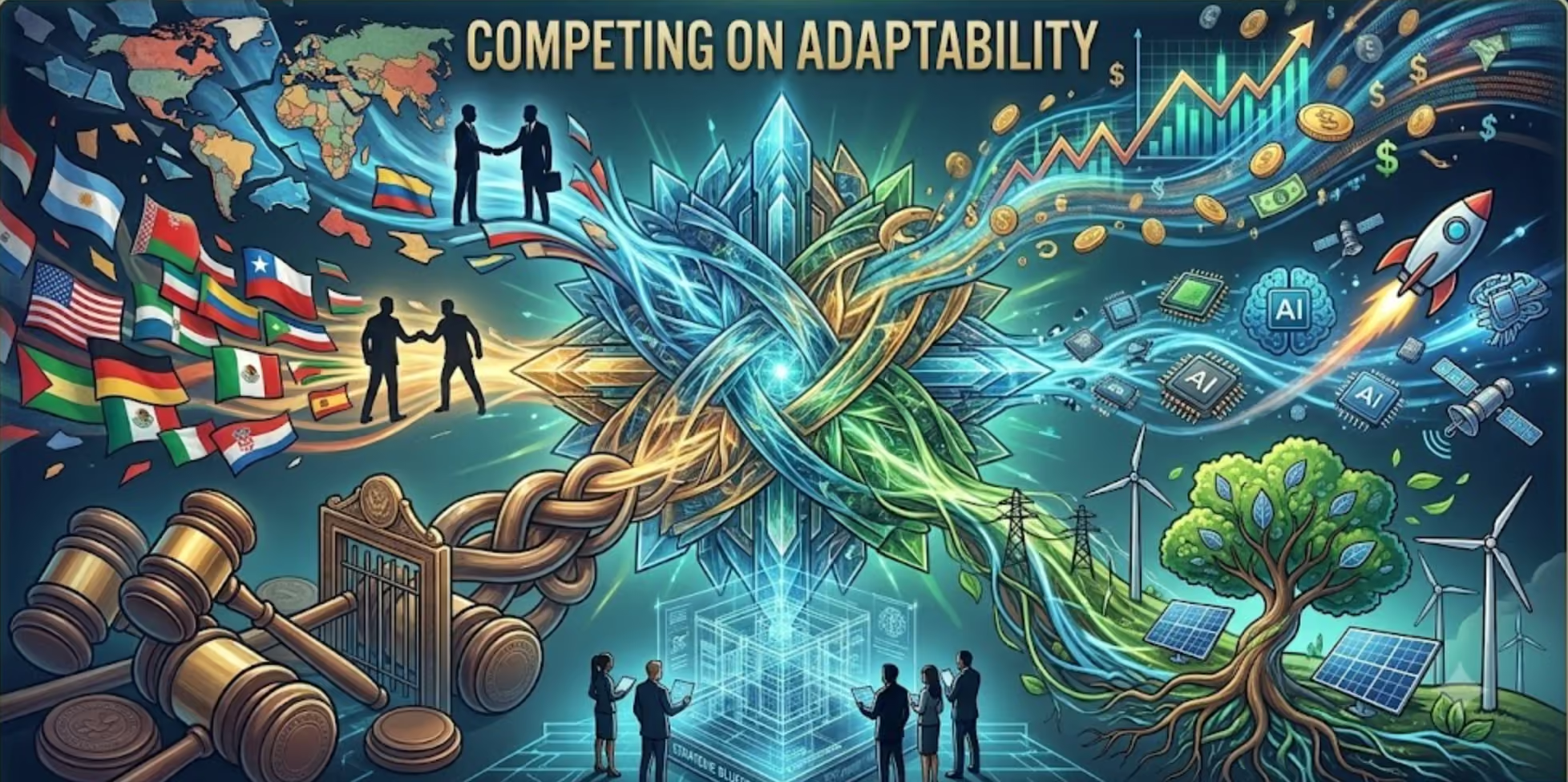
This is the defining characteristic of the Transformation Economy. It is not an environment of isolated disruptions requiring tactical responses. It is a structural economic condition in which multiple forces of change evolve simultaneously, interact continuously, and erode the advantages that organizations built under a different set of assumptions.
The organizations that succeed in this environment will not necessarily be the largest, the most innovative, or the fastest-growing. They will be those capable of continuously adapting their strategy, governance, operating model, technology, and workforce while maintaining strategic clarity and governance discipline. Adaptability has ceased to be an organizational aspiration. It has become an economic asset.
Forty-two percent of global CEOs name transformation speed as their single greatest concern — well ahead of concerns about innovation capability or long-term viability. The problem is no longer a lack of awareness. It is the absence of the enterprise architecture to act on it.
The Global Forces Reshaping Enterprise Strategy
The most dangerous misread available to executive leadership is to treat the forces reshaping enterprise strategy as independent trends requiring independent responses. They are not. They are interconnected structural forces that amplify each other, compress the windows of strategic advantage, and create a system of continuous change that no single initiative can resolve.
Geopolitical Fragmentation and Trade Realignment
The WEF Global Risks Report 2026 confirms that geoeconomic confrontation has become the defining near-term risk for global business, with 18% of respondents identifying it as the risk most likely to trigger a material global crisis in 2026. Trade restrictions, sanctions, investment screening, and the weaponization of supply chains are not temporary negotiating tools. They represent a structural reconfiguration of the global economic order.
BCG’s analysis of the new supply chain challenge documents how four megatrends, the rise of economic statecraft, heightening climate risk, wider adoption of robotics, and intensifying competition for manufacturing talent, are simultaneously disrupting global supply chain architecture. Organizations that designed their operating models for a rules-based, open global economy are discovering that those models carry structural fragility they did not price.
Energy Transition as Industrial Strategy
The IEA’s World Energy Investment analysis confirms that global energy investment reached an all-time high of $3.3 trillion in 2025, with $2.2 trillion flowing into clean energy technologies. For the first time in a generation, investment in electricity supply exceeds investment in fossil fuel extraction by 50 percent. The energy transition is no longer a climate project. It is an industrial strategy, and it is reshaping cost structures, competitive positioning, and market access across every capital-intensive sector.
The IEA’s State of Energy Innovation 2026 found that 80% of energy experts now place energy security among the top three drivers of innovation, ahead of affordability, emissions reduction, and national economic performance. Organizations that treat energy transition as a sustainability reporting exercise rather than a strategic variable are mispricing a structural cost and access risk.
AI Acceleration and the Speed of Business Model Disruption
Artificial intelligence is not simply changing what organizations can do. It is changing how quickly competitive advantage can be built and destroyed. PwC’s CEO Survey confirms that the most common concern among global leaders is whether their organizations are transforming fast enough to keep pace with AI. Yet the same data reveals that 56% of CEOs have seen no significant financial benefit from AI to date, and only 12%, those who have embedded AI extensively across products, services, and strategic decision-making have achieved both cost and revenue gains.
The divergence between AI investment and AI return is not primarily a technology problem. It is an organizational design problem. Deloitte’s State of AI in the Enterprise research confirms that only one-third of organizations are using AI to deeply transform, creating new products, services, or fundamentally reinventing core processes. The remaining two-thirds are using AI at a surface level, with little or no change to the underlying operating model.
Shifting Capital and Investor Expectations
Capital markets are repricing enterprise risk with increasing sophistication. Investors are no longer simply rewarding revenue growth and cost efficiency. They are evaluating governance quality, resilience architecture, sustainability performance, and the credibility of transformation strategy. PwC research confirms that companies that reinvent well, adapting their business and operating models effectively, achieve a typical 71% performance premium across profit margin and revenue growth metrics.
The IMF’s analysis of the interplay between geopolitical fragmentation and capital flows confirms that elevated uncertainty, more protectionism, and labor supply shocks could significantly reduce growth and destabilize financial markets. The organizations best positioned to navigate this environment are not those that have hedged most conservatively. They are those with operating models capable of redirecting capital and capability at speed when the environment demands it.
These forces do not operate in isolation. Energy transition reshapes industrial cost structures at the same moment geopolitical fragmentation is disrupting supply chains. AI accelerates competitive pressure while regulatory complexity multiplies governance obligations. Investor expectations evolve in step with the sustainability and technology landscape. The result is not a set of trends to be tracked. It is a structural system of continuous change that is the operating environment of the modern enterprise.
Source: Pacepoint Advisory synthesis from IMF, WEF, IEA, PwC, and Deloitte research (2025–2026).
Why Competitive Advantage Is Being Rewritten
For most of modern economic history, competitive advantage was built on three foundations: scale, efficiency, and cost leadership. Larger organizations could produce at lower unit cost. More efficient organizations could sustain higher margins. Organizations with superior cost positions could undercut competitors and still generate returns.
These foundations were effective because they were designed for a relatively stable, predictable environment in which market positions persisted, capital was inexpensive, technology evolved gradually, and supply chains were geographically stable. That environment no longer exists in most industries.
The Erosion of Traditional Competitive Position
Martin Reeves and Mike Deimler’s foundational work in the Harvard Business Review articulated the inflection point with clarity: traditional approaches to strategy assume a relatively stable and predictable world. But globalization, new technologies, and greater transparency have combined to upend the business environment. Sustainable competitive advantage no longer arises from positioning or resources alone. Instead, it stems from the organizational capabilities that foster rapid adaptation.
This observation, first advanced in 2011, has only deepened in its relevance. The pace at which competitive positions are built and eroded has accelerated markedly. McKinsey’s operating model research confirms that even high-performing companies now achieve only approximately 70% of their strategies’ full potential, attributing this strategy-to-performance gap directly to shortcomings in their operating models.
PwC’s data on cautious companies, those whose leaders reduce investment in response to geopolitical uncertainty, is instructive: they grow more slowly by two percentage points and maintain profit margins three percentage points lower than peers who continue to adapt and invest. Caution in the face of structural change is not a risk management strategy. It is a performance penalty.
The Emergence of Adaptability as an Economic Asset
Deloitte’s 2026 Global Human Capital Trends survey, drawn from a global study of business leaders, found that 7 in 10 executives say their primary competitive strategy over the next three years is to be fast and nimble to quickly adapt to and capitalize on changing business, customer, and market needs. Adaptability is no longer a desirable organizational quality. It is the stated competitive strategy of the majority of global enterprise leaders.
BCG’s business resilience framework characterizes this directly: resilient companies enjoy better outcomes across three dimensions, the impact of external shocks is lesser, the speed of recovery is faster, and the extent of recovery is greater. The organizations that build these capabilities are not simply more resistant to disruption. They are structurally better positioned to capitalize on the opportunity’s disruption creates for competitors who have not.
From Organizational Redesign to Continuous Evolution
McKinsey’s 2025 survey of 2,000 executives on operating model redesign confirmed a meaningful improvement in outcomes over the past decade: the share of redesigns meeting most objectives and improving performance rose from 21% in 2014 to 63% in 2025. Organizations are becoming more capable of redesigning. The more important question is whether they are building the organizational architecture to make redesign unnecessary, because continuous evolution has replaced periodic transformation as the operating philosophy.
This is the strategic shift that the Transformation Economy demands. Transformation is no longer a project or a program. It is an operating philosophy. The organizations that treat it as a discrete initiative, to be launched, completed, and concluded, will find themselves perpetually behind the pace of structural change. The organizations that institutionalize adaptability as an enterprise capability will not be responding to disruption. They will be outrunning it.
Transformation is no longer a project. It is an operating philosophy. The organizations that launch transformation programs without redesigning the enterprise architecture to sustain continuous change will repeat the cycle indefinitely.
Source: Pacepoint Advisory, adapted from Reeves & Deimler (HBR, 2011), Deloitte (2026), McKinsey (2025).
The Adaptive Enterprise: Designing Organisations for Continuous TRANSFORMATION
The Transformation Economy does not require organizations to abandon strategic discipline. It requires them to redefine it. The adaptive enterprise is not one that responds to every signal of change with structural reorganization. It is one that has built the architecture, culture, and governance to evolve continuously without losing strategic clarity or operational effectiveness.
The characteristics that define adaptive enterprises are observable in organizations that have consistently outperformed their peers across cycles of disruption. They are not dependent on a particular industry, geography, or size. They are architectural choices.
What Adaptation Looks Like in Practice
The gap between the organizations that navigate structural change successfully and those that do not is not primarily a gap in awareness or intent. It is a gap in organizational design. McKinsey’s 2025 research on operating model effectiveness identified that organizations seeking to build leaner, more adaptable systems are no longer simply tweaking structures. They are rethinking the fundamental relationship between structure, strategy, and execution.
Deloitte’s 2025 Boardroom research found that 73% of boards surveyed have stepped up their engagement in strategy development and scenario planning. This is not governance overreach. It is a rational response to an environment in which strategy and risk are no longer sequential. They are simultaneous.
Harvard Business Impact’s 2025 Global Leadership Development Study documented that 40% of senior leaders report their organizations are placing greater emphasis on building change-ready cultures. But the data makes clear that readiness alone is insufficient. The organizations moving furthest are those building what the research describes as “change-seeking” cultures, ones that proactively scan for opportunity, challenge assumptions, and move before disruption demands it.
The Transformation Economy rewards neither the fastest nor the largest. It rewards the organizations most capable of sensing structural change, adjusting their architecture in response, and sustaining strategic coherence through the adjustment. That is the definition of the adaptive enterprise. And it is the design challenge that every board and executive team in every sector must now address.
The adaptive enterprise is not built through transformation programs. It is built through intentional design choices about strategy, governance, operating models, technology, and culture that are made explicitly to sustain continuous evolution.
The Challenge for Leadership
The question facing leadership teams is no longer whether to transform. In a Transformation Economy, that question has been rendered obsolete. The only available strategy is one that builds the organizational capability to transform continuously. The question that matters is whether the organization has been deliberately designed to do so.
The evidence of failure on this question is significant. Most executive teams recognize the strategic imperative. PwC’s survey data confirms that in 2025, nearly four in ten CEOs said their company would not be viable in 10 years if it stayed on its current path. Yet the same research documents a paradox: CEOs who are most aware of the transformation imperative tend to spend the most time on short-term activities. Awareness of the problem does not produce the organizational response to it.
McKinsey’s transformation research reinforces this pattern. 2025 began with shifting tariffs, volatile trade relationships, and disrupted supply chains. The organizations that responded most effectively were not those with the most sophisticated disruption detection capabilities. They were those whose operating models had been designed for reconfiguration, whose governance structures enabled faster decisions, whose technology platforms allowed rapid reallocation of capability, and whose leadership cultures treated disruption as data rather than crisis.
The failure mode in the Transformation Economy is not ignorance of structural change. It is the continuation of transformation as a series of isolated programs technology implementations, organizational restructurings, strategy refreshes that address symptoms without redesigning the enterprise architecture that produces them.
Every isolated transformation program eventually collides with the operating model it was not designed to change. Every technology investment eventually reveals the governance and cultural constraints it cannot overcome. Every strategic initiative eventually runs against the organizational inertia that the enterprise design perpetuates.
The organizations that will define competitive performance in the Transformation Economy are not those that respond to disruption more quickly. They are those that have made the organizational design choices required to evolve continuously: strategies built on scenario foresight rather than point-in-time planning, governance that accelerates rather than impedes strategic response, operating models designed for flexibility rather than permanence, technology embedded as an enterprise-wide capability rather than a departmental tool, and leadership cultures that treat learning as a competitive asset.
This is the perspective that Pacepoint Advisory brings to the organizations it works with. Building the adaptive enterprise is not a question of ambition or intent. It is a question of design. And the organizations that begin building that design now will hold structural advantages over those that wait for disruption to force the question.
The competitive advantage of the future will not belong to organizations that simply manage change better. It will belong to those deliberately designed to evolve — where adaptability is not an aspiration but an enterprise capability embedded in strategy, governance, operations, and culture.
Conclusion
The Transformation Economy is not a phase. It is the permanent operating condition of enterprise competition. The organizations that succeed will not be those that managed individual disruptions most effectively. They will be those that built the organizational architecture to evolve continuously, with the strategic clarity and governance discipline to turn structural change into sustained advantage.
Five structural forces, geopolitical fragmentation, energy transition as industrial strategy, AI acceleration, regulatory complexity, and shifting capital expectations, are now interacting continuously rather than unfolding in sequence. The evidence is unambiguous: 68% of global leaders now expect a fragmented world order over the next decade; CEO confidence in revenue growth has fallen to a five-year low of 30%; and 56% of organizations have realized no financial benefit from their AI investment to date. These are not isolated indicators. They are symptoms of the same underlying condition, an operating environment in which the assumptions that built traditional competitive advantage no longer hold.
That diagnosis carries a direct strategic implication. The sources of advantage that defined the last era of business, scale, cost leadership, efficiency, and operational permanence, are eroding. In their place, adaptability, strategic agility, learning velocity, governance maturity, and embedded resilience are becoming the measurable drivers of enterprise value. PwC’s research confirms the magnitude of that shift directly: organizations that reinvent their business and operating models well achieve a 71% performance premium over those that do not.
The organizations closing that gap are not relying on isolated transformation programs. They are deliberately designing six characteristics into their enterprise architecture: strategic foresight in place of long-range certainty; governance structured to accelerate rather than slow decision-making; operating models built for flexibility rather than permanence; technology embedded as an organization-wide capability; cultures of disciplined experimentation; and resilience treated as a strategic asset rather than a defensive posture. None of these characteristics is achieved through a single initiative. Each is the product of an explicit design choice, sustained over time.
That is the defining competitive question of the Transformation Economy. Not: how does my organization manage this cycle of disruption? But: have we designed an enterprise capable of evolving continuously, across every cycle of disruption that follows?
The organizations that answer that question with design choices, in strategy, governance, operating models, technology, and culture, rather than aspiration statements will define the competitive landscape of the next decade.
References
- World Economic Forum (2026). Global Risks Report 2026: 21st Edition. Geneva: World Economic Forum. Published January 14, 2026.
- International Monetary Fund (2026). World Economic Outlook: Global Economy in the Shadow of War. Washington, D.C.: IMF. April 2026.
- PwC (2026). Leading Through Uncertainty in the Age of AI: PwC’s 29th Global CEO Survey. London: PricewaterhouseCoopers International Ltd. January 19, 2026.
- Boston Consulting Group (2025). Balancing Cost and Resilience: The New Supply Chain Challenge. BCG Publications. August 2025.
- International Energy Agency (2025). World Energy Investment 2025: Executive Summary. Paris: IEA. Published May 2025.
- International Energy Agency (2026). The State of Energy Innovation 2026. Paris: IEA. Published March 2026.
- Deloitte (2026). The State of AI in the Enterprise: 2026 AI Report. Deloitte AI Institute. Based on survey of 3,235 leaders, August–September 2025.
- Reeves, M. and Deimler, M. (2011). Adaptability: The New Competitive Advantage. Harvard Business Review, July–August 2011. Reprint R1107M.
- McKinsey & Company (2025). The New Rules for Getting Your Operating Model Redesign Right. McKinsey People & Organisational Performance Practice. June 2025. Based on survey of 2,000 executives across 16 sectors.
- Deloitte (2026). 2026 Global Human Capital Trends. Deloitte Insights. June 2026.
- Boston Consulting Group (2025). Business Resilience: Sense, Adapt, Thrive, and Transform. BCG Capabilities Insights.
- Deloitte (2026). Building Organizational Resilience. Deloitte Global Boardroom Program and CEO Program. Survey of 739 board and C-suite leaders across 59 countries. March 2026.
- Harvard Business Impact (2025). Readiness Reimagined: How to Build a Change-Seeking Culture. 2025 Global Leadership Development Study. Harvard Business Publishing.