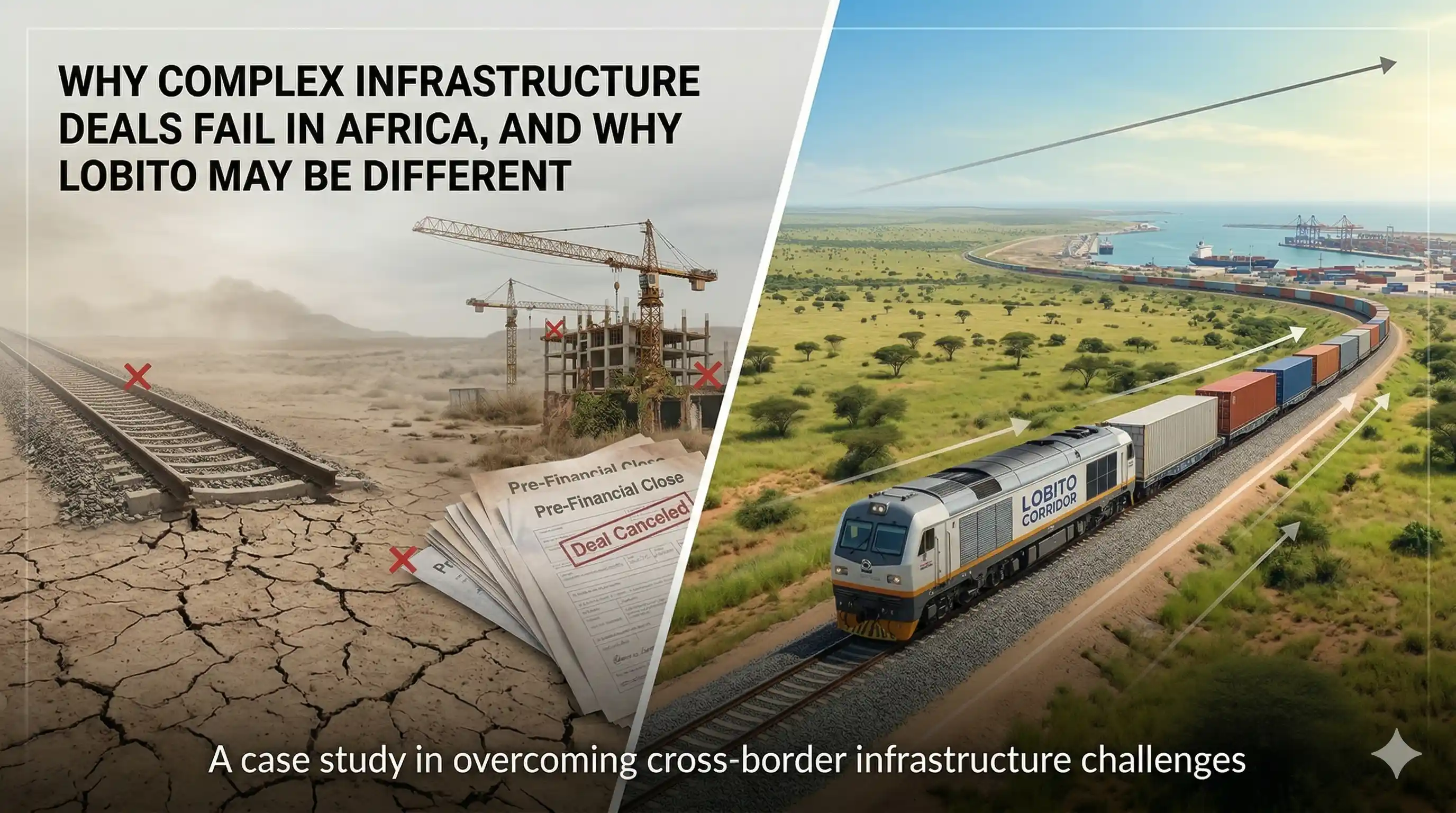
.avif)
It is arguably one of the most important infrastructure PPPs in Africa today. Not simply because of its size, but because of what it represents and what could follow.
The Lobito Corridor is not just another rail concession.
It is a serious, large-scale test of whether Western governments, development finance institutions, and private investors can support a credible, commercially viable infrastructure model in Africa, and deliver it on time, at scale, and with meaningful local benefit. That is a high bar, but this deal has been structured to give it a credible chance of success.
What is being built: At its core, the project involves roughly 1,300 km of upgraded railway from the port of Lobito to the DRC border, together with a dedicated mineral terminal to move Copperbelt copper and cobalt to the Atlantic. The 30-year PPP concession was awarded to Lobito Atlantic Railway, a consortium of Trafigura, Mota-Engil, and Vecturis. On the surface, that sounds straightforward. What makes it important is the way it has been financed and the broader strategy behind it.
Why the financing structure matters
This is not a standard deal built around a single government guarantee and a single private operator. It is a multi-partner financing structure designed to spread risk and make a complex project investable. The US Development Finance Corporation (DFC) has committed approximately $553 million, a 15-year senior loan for the Angolan railway and mineral terminal upgrade. Development Bank Southern Africa (DBSA) and other European institutions are adding further debt, pushing corridor-related G7 and regional financing into the multi-billion-dollar range. The EU’s Global Gateway and the G7’s Partnership for Global Infrastructure and Investment frame this explicitly as strategic infrastructure rather than traditional development assistance. The result is a blended structure in which private concessionaire obligations sit alongside long-tenor DFI debt, bilateral de-risking instruments, and upstream multilateral project preparation support. Each layer addresses a different investor concern. Together, they create a financing model that would have been very difficult to deliver on a purely commercial basis.
What makes the Lobito model different
First, it builds on an existing railway asset in Angola but is designed with a much wider corridor ambition in mind. While the current concession focuses on the Angolan section, the broader vision extends across the corridor, including new links into Zambia, rehabilitation in the DRC, and related investments in trade facilitation, power, agriculture, and skills. That matters because the PPP is intended to create value far beyond the railway itself.
Second, strategic outcomes are built into the mandate. The corridor is explicitly framed around secure, transparent, and sustainable critical mineral supply chains, with a strong emphasis on ESG standards, local economic impact, and supply chain diversification. This is not peripheral language. It is central to understanding why the G7 and multilateral institutions are participating and why the deal differs from a standard extractive infrastructure transaction.
Third, governance is the real test. In my experience advising on projects across Africa, financing is rarely the main reason projects fail. More often, problems emerge through weak coordination, poor benefit-sharing arrangements, and governance gaps across multiple sovereign jurisdictions. Lobito’s success will depend on getting that right, not just on the financing.
Why this matters beyond the Lobito Corridor
.webp)
If Lobito delivers, it will demonstrate three things that matter for the next generation of African infrastructure investment:
- Corridor PPPs can be structured with multi-sovereign and multi-partner support from the outset, rather than being put together later when a project is already under pressure.
- Critical mineral strategies and infrastructure PPPs can be developed together, aligning rail, ports, energy, and local industry within a single investment framework
- Western and African institutions can co-finance at scale when there is a credible operator, a clear corridor vision, and strong governance.
The pipeline implications are significant. As African governments and their partners move into nickel, lithium, green hydrogen, and transmission corridors, the Lobito model offers a strong example of how to structure projects that are commercially viable, strategically aligned, and capable of delivering broader development value. By 2030, I expect at least three Lobito-style corridor PPPs to be in active structuring across Sub-Saharan Africa. In my view, the strongest candidates are the Liberty, Northern, and Nacala corridors. Each has a different risk profile, but all offer useful lessons for the next generation of corridor PPPs. However, while the Lobito model is promising, three risks remain central: governance across multiple countries, local benefit-sharing, and tariff affordability. These will determine whether such corridors support broader economic transformation or mainly facilitate exports. The real question is not whether capital is available, but whether the governance frameworks are strong enough to deploy it effectively. I have worked on PPPs, energy, and infrastructure investment across Africa and other emerging markets, but this is the kind of deal where wider perspectives really matter. For those working in DFI, infrastructure investment, and African energy, which part of the Lobito model is most replicable, and where do you see the main risks?