
If AI Can Do the Analysis, What Are Consultants Being Paid For?
For decades, the consulting model has been relatively easy to understand. A small number of experienced partners sit at the top, supported by layers of managers, associates and analysts underneath them. Much of the research, benchmarking, modelling, synthesis and presentation-building happens lower down the pyramid before eventually becoming advice delivered to the client.
Artificial intelligence (AI) is beginning to challenge the economics of that structure.
This is no longer theoretical. Across consulting and other professional-services firms, AI is already changing entry-level work, hiring practices and the skills expected of junior professionals. As routine analytical tasks are automated, firms are placing greater emphasis on judgement, AI fluency, specialist expertise and client-facing capabilities. (Financial Times,2026)
The question for consulting firms is therefore bigger than whether they use AI. It is what remains worth paying a consultant for when much of the traditional analytical work becomes faster, cheaper and increasingly accessible to the client themselves.
Analysis Is Becoming Easier to Buy
Research was once scarce because expertise, information and analytical capacity were scarce.
That is changing. AI can already accelerate market scans, summarise regulations, analyse documents, interrogate datasets, develop initial hypotheses and produce first drafts of presentations in a fraction of the time previously required. (McKinsey Global Institute, 2023)
For the client, this changes expectations. If a consulting team once required several analysts and multiple weeks to produce an initial evidence base, it becomes increasingly difficult to justify the same fees simply because the traditional consulting process says it should take that long.
Other professional-services industries are already confronting similar pressure. AI is contributing to a broader movement away from pricing based primarily on people and hours towards pricing based on outputs and outcomes. (Reuters, 20 Aug 2026)
That is potentially uncomfortable for firms whose commercial models have historically depended on leveraging large junior teams.
But it does not make consultants obsolete.
It changes where their value has to come from.
A successful consultancy in five years will probably look less like a large pyramid of analysts and more like a small, senior, technology-enabled network with deep field reach.
AI will handle much of the desk research, synthesis, modelling, transcription, monitoring and first-pass analysis. Robotics and remote-sensing tools will increasingly support physical verification, infrastructure inspection, agricultural monitoring and other forms of evidence gathering. But the consultancy's real advantage will sit in the parts that are hardest to automate: knowing which stakeholders matter, understanding why institutions behave the way they do, testing whether reported information is actually true, and interpreting what local realities mean for a decision. (McKinsey Global Institute, 2023; World Bank, 2026)
In areas like stakeholder engagement, Political Economic Analysis (PEA), Monitoring & Evaluation (ME) and verification, the winning firms will combine AI-generated intelligence with trusted human networks on the ground. They will be able to move quickly from satellite imagery, administrative data and automated analysis to a conversation with a regulator, community leader, business owner or field enumerator who can explain why the data looks the way it does. (World Bank GEMS)
So, the scarce product will no longer be information. It will be verified context.
The consultancy of the future will therefore sell less "research and reports" and more continuous decision intelligence: technology to detect what is changing, local networks to verify it, experienced advisers to interpret it, and senior judgement to tell the client what to do next.
The Valuable Part Was Never the PowerPoint
Organisations rarely bring in advisers simply because they are incapable of gathering information. They engage advisers because difficult decisions involve uncertainty.
Which market should we enter? Which programme should we stop funding? Why is implementation failing? Which stakeholder can block this reform? What happens politically if we choose one option over another? What risks are hidden in the numbers?
AI can dramatically improve the evidence available for answering these questions. It cannot assume accountability for the decision. The premium therefore moves towards judgement, context, interpretation, challenge and execution.
A strong adviser must know when the available evidence is misleading, when the technically optimal recommendation is institutionally impossible, when a stakeholder's stated position differs from their actual incentives and when the problem a client has commissioned is not the problem they actually need solved.
That judgement is built through experience. And therein lies another problem...
If AI Replaces the Bottom of the Pyramid, Who Becomes the Next Partner?
Junior consulting work has never only been about producing outputs. It is also how consultants learn.
Hours spent researching sectors, building models, sitting in stakeholder interviews and watching experienced advisers challenge assumptions gradually create the judgement expected from senior consultants. If AI absorbs much of this work, firms cannot simply remove junior roles without reconsidering how the next generation develops expertise. (Financial Times, 2026)
Recent changes across professional services already point towards this shift. Ernst & Young, for example, is redesigning parts of its early-career development model as AI changes what entry-level professionals are expected to do. EY US is transforming its entry-level talent development by replacing the traditional eight-week internship with the EY Career Residency, an immersive 8- to 12-month paid program. This new initiative allows students to blend their academic studies with hands-on client work, structured skills development, and professional coaching. Designed to cultivate critical thinking, professional judgment, and AI fluency for a technology-driven future, the residency prepares participants to be "day one-ready" leaders. Upon completion, successful participants can join EY full-time in the elevated role of analyst, a title that reflects the advanced experience and capabilities they have gained. The program is part of EY's broader effort to reimagine professional development, with the first cohort set to launch in January 2028. (EY, 17 Aug 2026)
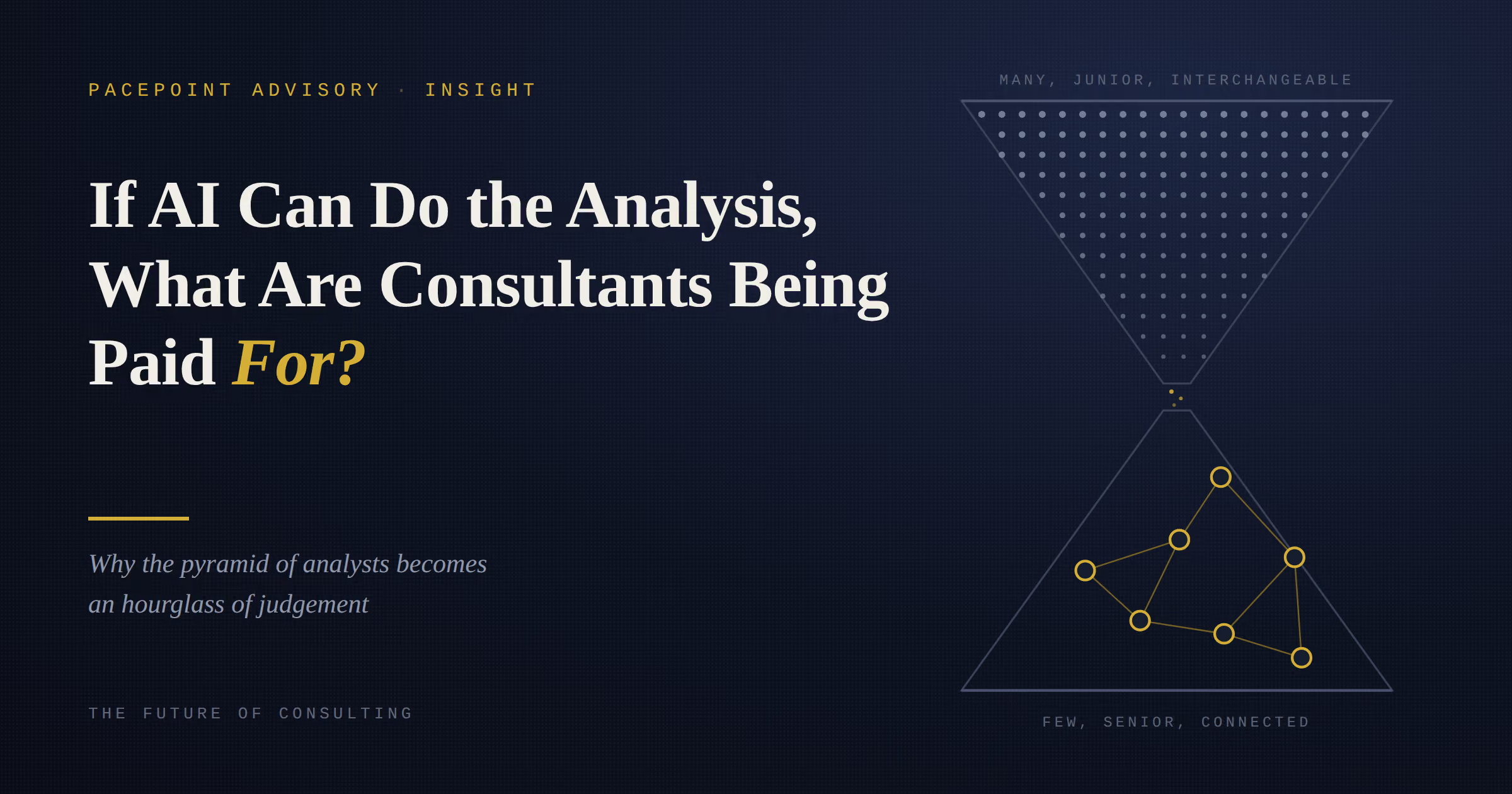
The future consulting firm may therefore look less like a pyramid and more like an hourglass: fewer people conducting routine analysis, more technology doing the heavy lifting, and significant value concentrated around experienced advisers and specialist expertise.
But that model only works if firms deliberately build the talent pipeline required to sustain it.
Recommendation
- Automate the repeatable work first. Start with low-risk tasks: desk research, transcription, document review, survey cleaning, first-pass coding, evidence synthesis, proposal drafting and basic M&E reporting. The goal is not "AI adoption" as a slogan, but reducing the amount of expensive human time spent on work machines can already do well.
- Redesign junior roles around judgement, not production. This is the harder organisational shift. Firms should stop training young consultants mainly to build slides and summarise documents, and instead expose them earlier to client conversations, stakeholder interviews, fieldwork, hypothesis testing and interpretation. EY's direction is useful here: if AI removes traditional entry-level tasks, firms need a new apprenticeship model rather than simply fewer juniors.
- Bridge the gap between large and boutique consultancies. Building proprietary access and verification networks is one of the most challenging capabilities to replicate, but the advantage varies by firm size. Larger consultancies compete through capital, investing in proprietary datasets, specialist platforms, global expert networks, and deep relationships with government, policy, and implementation. Boutiques compete by developing deep expertise in specific geographies or sectors and building the trusted local networks, field partnerships, specialist knowledge, and verification systems needed to answer a critical question: what is happening on the ground and why? For boutiques, scale can become an advantage rather than a constraint. The senior expert is directly involved in delivery, and this creates ground-level trust, contextual judgment, and knowledge that take years to build and cannot be quickly purchased or reconstructed by an AI model. That makes these capabilities an increasingly important source of differentiation as AI makes more generic research and analysis easier to replicate.
Consulting Is Not Disappearing. Mediocre Consulting Might.
The firms most exposed to AI are not necessarily those with the fewest AI tools. They are those whose value proposition can be reproduced without them. If an engagement consists primarily of gathering publicly available information, synthesising it and presenting it attractively, clients will increasingly question why they are paying traditional consulting rates.
The defensible consulting firm of the next decade will have to offer something harder to automate: proprietary insight, sector depth, trusted relationships, local context, implementation capability and experienced judgement.
AI should make those firms better.
It should allow consultants to spend less time assembling information and more time interrogating it. Less time formatting recommendations and more time understanding whether those recommendations will actually work.
The real threat AI poses to consulting, therefore, is not that machines will suddenly become better advisers than people. It is that AI will make it much easier for clients to distinguish analysis from advice.
And firms that have been charging advisory prices for analytical work may find that distinction uncomfortable.
Note: Forecasts and recommendations in this article are Pacepoint Advisory's analysis. References are used for external factual claims and examples, not to imply that the sources endorse Pacepoint's conclusions.
References
1. Armstrong, R. (2026). ‘Who needs consultants in the age of AI?’. Financial Times, 10 August 2026.
2. McKinsey Global Institute (2023). ‘The economic potential of generative AI: The next productivity frontier’. McKinsey & Company.
3. Reuters (2026). ‘AI reshapes India’s IT services sector contracts as clients demand more for less’, 20 August 2026.
4. World Bank (2026). ‘Modeling and Reporting Consulting Firm for Crop Monitoring and Production Pilot in Honduras’. Procurement notice, 5 June 2026.
5. World Bank. ‘Geo-Enabling initiative for Monitoring and Supervision (GEMS)’. World Bank Group.
6. Ernst & Young LLP (2026). ‘From intern to leader: EY US introduces Career Residency program to transform entry-level professional experience’, 17 August 2026.
7. Cousins, F. (2026). ‘How consultants ensure advice is worth paying for’. Financial Times, 18 August 2026.
8. Financial Times (2026). ‘AI isn’t destroying entry-level jobs. It’s changing them’, 17 July 2026.
Note: Forecasts and recommendations in this article are Pacepoint Advisory’s analysis. References are used for external factual claims and examples, not to imply that the sources endorse Pacepoint’s conclusions.