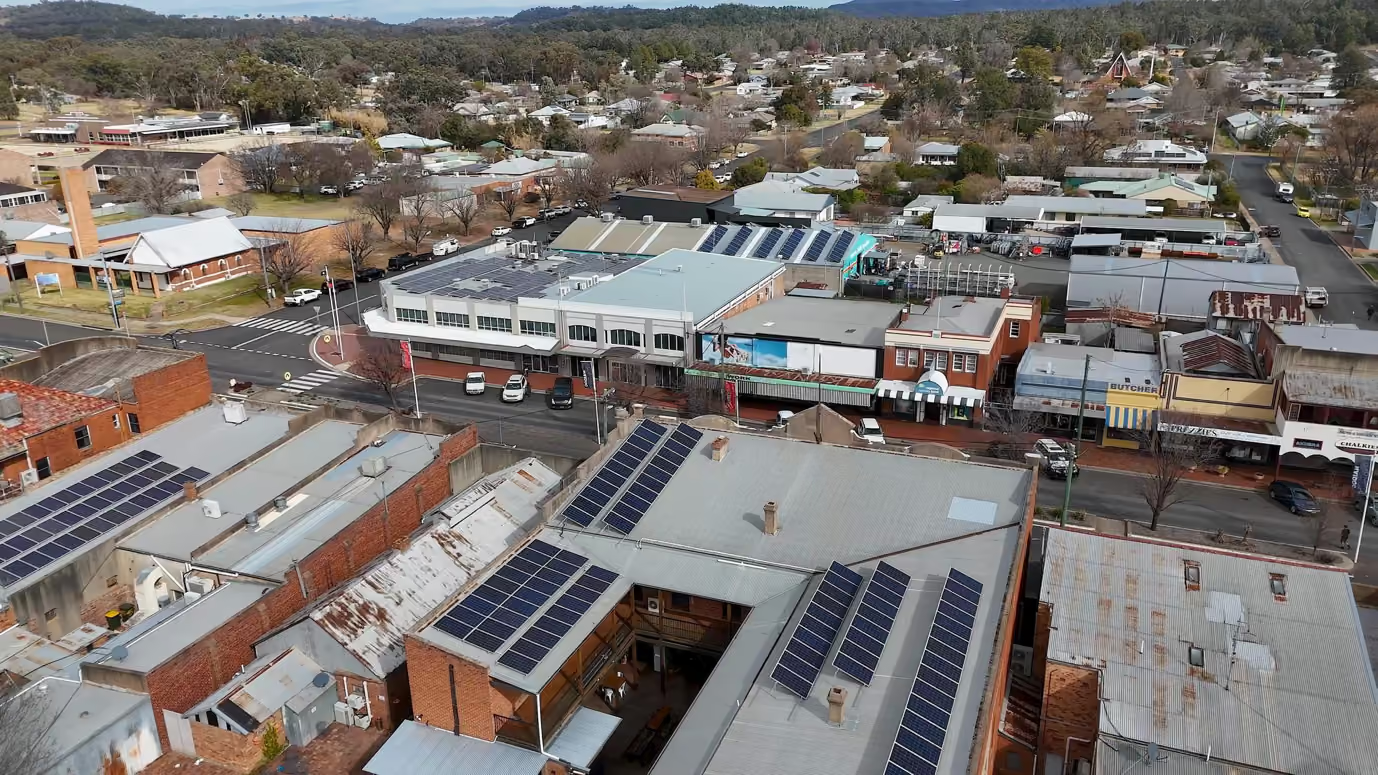

In 2025, official development assistance fell by 23.1 per cent in real terms, the largest annual contraction in the history of ODA. Every donor budget is now being interrogated for evidence of lasting impact. It is the worst possible moment to still be funding infrastructure that stops working within three years of handover. And yet that is precisely what the development sector continues to do.
The sector is exceptionally good at delivery. Roads get built. Clinics get equipped. Schools get constructed. Solar systems get installed. Project teams hit their targets, budgets are spent on schedule, and completion reports document success with photographs and metrics to match. Governments shake hands at handover ceremonies. Donors close the books. What the sector has never resolved is what comes next.
The road degrades without a maintenance budget. The clinic’s equipment sits unused because no technician was trained to operate it. The school’s infrastructure falls apart because the ministry that received it has no recurrent budget to sustain it. And the solar system, installed at significant cost to power the health facility, the school, the water pump, the agricultural cooperative, stops working because the operational architecture needed to sustain it was never designed, never funded, and never the subject of any formal accountability once the implementing team left the site.
Pacepoint’s position is direct: electrification without sustainability is not an energy problem. It is a development delivery problem, one that is embedded in how the sector defines success, structures accountability, and measures impact. This paper names the failure, examines what must change, and closes with the Pacepoint Programme Sustainability Test: five questions that must be answered before the next project is approved
The Real Picture Behind the Numbers
Global electricity access has risen from 84 per cent in 2010 to 92 per cent in 2023, according to SDG 7 tracking data. That figure is cited in donor reports, strategy documents, and sector communications as evidence of progress. It is progress. But it is measuring the wrong thing.
Despite the 92 per cent headline, more than 1.18 billion people experience energy poverty, defined not as the absence of a connection, but as the absence of sufficient, reliable supply. The connection exists. The power does not. The World Bank estimates that around 40 per cent of utilities in developing countries are not financially sustainable. And in 2022, the number of people without electricity access increased for the first time in decades: population growth in areas without access outpaced new connections, even as investment in electrification continued at scale.
The reason these two realities coexist, rising investment alongside stalled or reversed outcomes, is that the sector’s primary metric counts the moment of installation, not the sustained delivery of energy service. A health facility that ran on solar during a donor programme and now uses kerosene lamps is counted as electrified. A school with a non-functioning inverter since 2021 is counted as electrified. A water pump awaiting a spare part for two years is counted as electrified.
Research by Cook and Elliott (2022) documents this directly: few solar systems installed through donor-funded programmes pass the five-year survival hurdle, primarily because of lack of institutional ownership. A 2024 systematic literature review found that the factors most critical to long-term project success, operation and maintenance funding, genuine institutional ownership, local technical capacity, are consistently the least addressed in programme design. The sector is measuring delivery. It is not measuring outcomes.
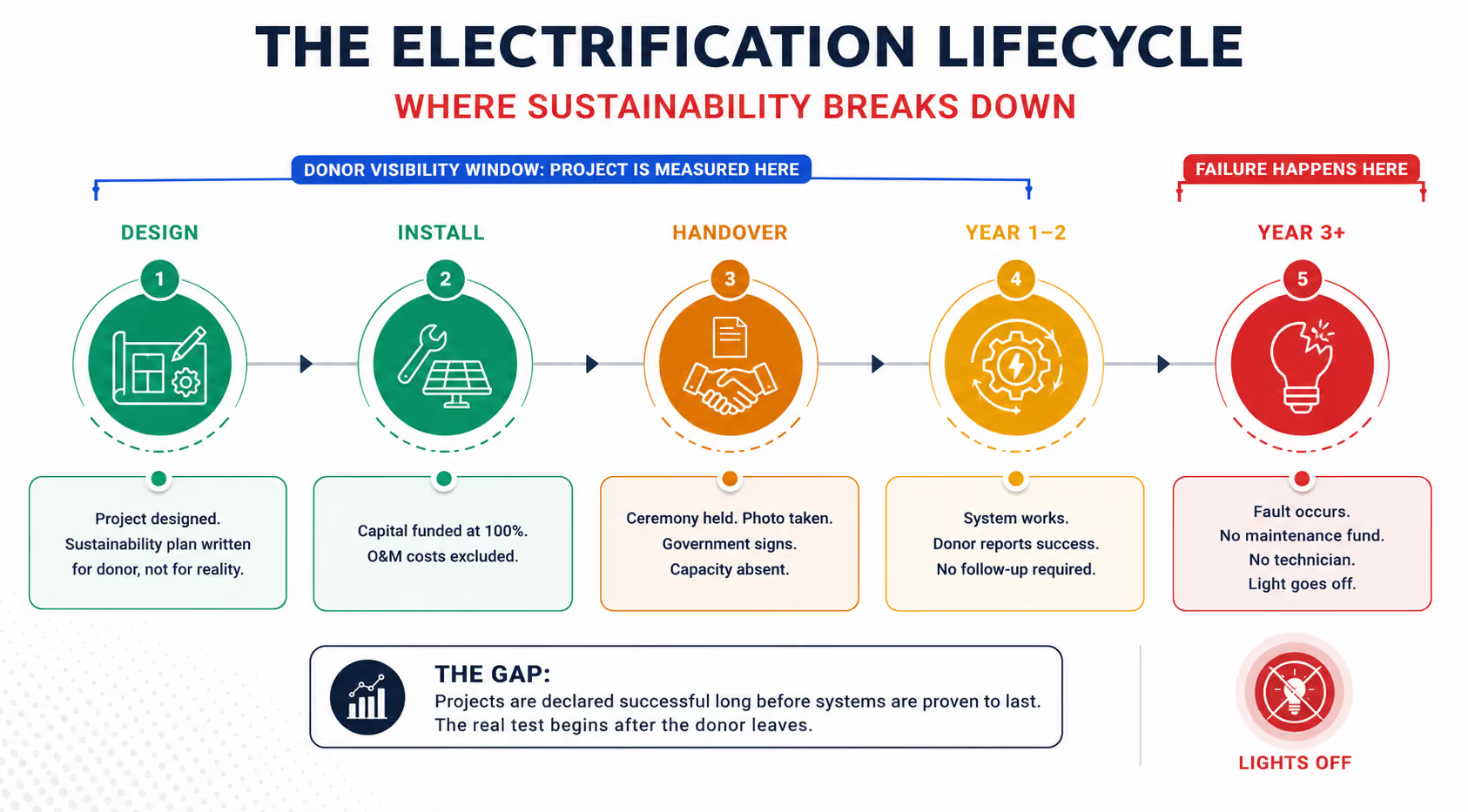
The diagram above makes visible what the access statistics obscure. The accountability window closes at handover. The failure arrives after it. The sector has built an entire measurement infrastructure around the wrong moment.
Four Design Failures
Donor funding cycles reward completion. Implementing organisations perform to delivery metrics. Government counterparts cannot acknowledge incapacity without political risk. Nobody in that chain is formally accountable for year three. This is not negligence. It is a system doing exactly what it was designed to do, and until the incentive structure changes, the design will not.
Success measured at the wrong point
A programme across thirty health facilities records 100 per cent delivery at project close. Three years later, twelve systems have a non-functioning component, seven have been cannibalised for parts, four have stopped entirely. The implementing organisation is on a different contract. The donor’s institutional memory has faded. In the next funding cycle, the same facilities appear as priority sites. According to the 2024 Energies review, absent post-project monitoring is among the most significant structural gaps in electrification programme design. The sector has no agreed standard for measuring whether a project is still working three years after completion. It has extensive frameworks for measuring whether it was completed on time. These are not the same question.
Recurrent costs excluded from funding
Capital is funded. Maintenance is not. Excluding O&M from programme budgets is a decision to fund a project that will not last, not a resource constraint. Research on off-grid projects in West Africa identifies this as one of the most consistent structural gaps in programme design across the region. The shift from asset transfer to service delivery, where the provider is accountable for energy delivered, not equipment installed, is available to every programme designer working today. The majority have not made it.
Counterpart presence confused with institutional capacity
The ministry that signs the handover certificate is not the same as the ministry that can operate what was handed to it. Cook and Elliott (2022) document this clearly: institutions that co-designed what they operate consistently sustain performance longer than those that received a completed system. Ownership is not a ceremony. It is demonstrated by who made the design decisions, and in most programmes, that answer is not the counterpart.
Sustainability treated as a reporting exercise
In one documented case from a solar-for-health programme, a facility’s system was offline for four months because nobody on site could reset the inverter following a power surge. The fix took a visiting technician eleven minutes. The knowledge gap had existed since handover. That is not an unusual story. It is the norm, the direct consequence of sustainability plans written for completion reports rather than for the institutions that have to implement them.
What Sustainable Electrification Actually Requires
Across every context where donor-funded electrification has been deployed, the conditions that determine whether a project lasts are the same. The technology varies. The institutional setting varies. The community dynamics vary. But the requirements for long-term operational sustainability are consistent, and they are sufficiently well understood that the sector’s continued failure to design for them is difficult to explain on grounds other than institutional incentive.
Genuine institutional ownership, built before installation
The Energies 2024 systematic review identifies institutional ownership as the single most important determinant of long-term electrification project performance. Institutions that actively participated in system selection, site planning, procurement, and installation consistently outperform those that received a completed system at handover. This is not a technical observation. It is an organisational one. When a ministry energy unit, a school board, a water cooperative, or an agricultural cooperative is involved in designing what it will operate, it understands the system, has a stake in its performance, and has the institutional knowledge to manage it.
Building genuine institutional ownership requires extending programme timelines, allocating budget to counterpart engagement, and accepting that installation will be slower when the institution is genuinely involved rather than ceremonially present. These are uncomfortable trade-offs for programmes under pressure to meet delivery targets. They are also the difference between a project that lasts and one that does not.
A funded operation and maintenance model from day one
The most effective electrification programmes treat operation and maintenance not as an afterthought but as the primary design challenge. The question they begin with is not ‘what system should we install?’ but ‘what system can this institution sustain, at what cost, with what funding mechanism, for how long?’ Cook and Elliott (2022) on off-grid solar for health and education documents emerging business models that have shifted from asset ownership to service delivery: the implementing partner or a private operator retains system responsibility under a long-term service agreement, funded through a combination of government budget and donor endowment. The institution receives the energy service rather than the physical asset. The provider is accountable for power delivered, not equipment installed.
In education contexts, community energy manager models, a trained individual within the school structure with basic technical certification, a defined maintenance budget, and a service pathway to a qualified technician network, have improved five-year system performance materially at modest additional cost. In water and agricultural contexts, tariff-based models with transparent cooperative governance work when introduced at the outset of the programme, not proposed at handover as a post-hoc solution to a sustainability problem the programme was not designed to address.
Local technical capacity that stays when the consultant leaves
The technical knowledge required to sustain an electrification system must sit within the institution that operates it, not within the implementing team that installed it. Cook and Elliott research on solar electrification of public facilities identifies the absence of local technical capacity as a primary driver of post-handover failure. Effective capacity building involves structured integration of institutional staff into system operation from the point of installation, a service chain accessible independently by the institution, and operational documentation in forms the institution can use without the implementing team’s continued involvement.
Post-project accountability embedded in programme design
Mandatory, funded, independent performance assessment at year three and year five changes programme design from the outset. Teams that know they will be evaluated on whether the infrastructure is still functioning make different decisions during design than teams evaluated only on whether it was handed over. That accountability shift, applied consistently across donors, implementing organisations, and government counterparts, does more to change sector behaviour than any sustainability framework produced for a completion report. The environmental footprint of electrification infrastructure, including battery lifecycle management, HSE protocols, and end-of-life component recovery, must also be embedded at this stage. Communities in the Global South are already absorbing the liability of the first wave of unmanaged solar waste. The sector created that liability. It should not repeat it.
The Pacepoint Programme Sustainability Test
The test below is a design gate, not an evaluation tool. It is intended to be applied before a programme is approved and before capital is committed. If any of the nine questions cannot be answered satisfactorily at the design stage, the programme is not ready to proceed, not because the will is absent, but because the architecture required to sustain the investment has not yet been built. A programme that cannot answer them has been designed for completion, not for sustainability.
These questions are not aspirational. They are operational. The evidence on what makes programme projects last is sufficiently clear that the persistent failure to design for these conditions is a choice, not an oversight. The Sustainability Readiness Assessment makes that choice visible at the point where it can still be corrected.
Conclusion
This year, the development sector will commission new electrification programmes on some of the same sites where programmes from five years ago are no longer functioning. That is not a funding gap. It is a design loop. And the sector is currently inside it.
The questions in the Pacepoint Programme Sustainability Test are not difficult to answer when a programme is genuinely built for long-term performance. They are very difficult to answer when it is built for handover. That difficulty is diagnostic, it tells you, before a single panel is installed, whether what is being designed is a durable outcome or a well-documented delivery. In an environment where ODA fell 23.1 per cent in 2025, the sector no longer has the budget, or the credibility, to keep funding the same loop.
The accountability shift is not complicated. Stop measuring how many systems were installed. Start measuring how many are still working. The sector has the evidence, the tools, and the experience to do this. The question is whether the institutions responsible for funding and implementing development infrastructure are willing to be held to that answer.
The development sector has spent considerable resources re-electrifying communities and institutions that were electrified before. That repetition is not evidence of persistent demand. It is evidence of a preventable failure, one the sector now has enough evidence, enough programme experience, and enough analytical tools to stop repeating.