.avif)

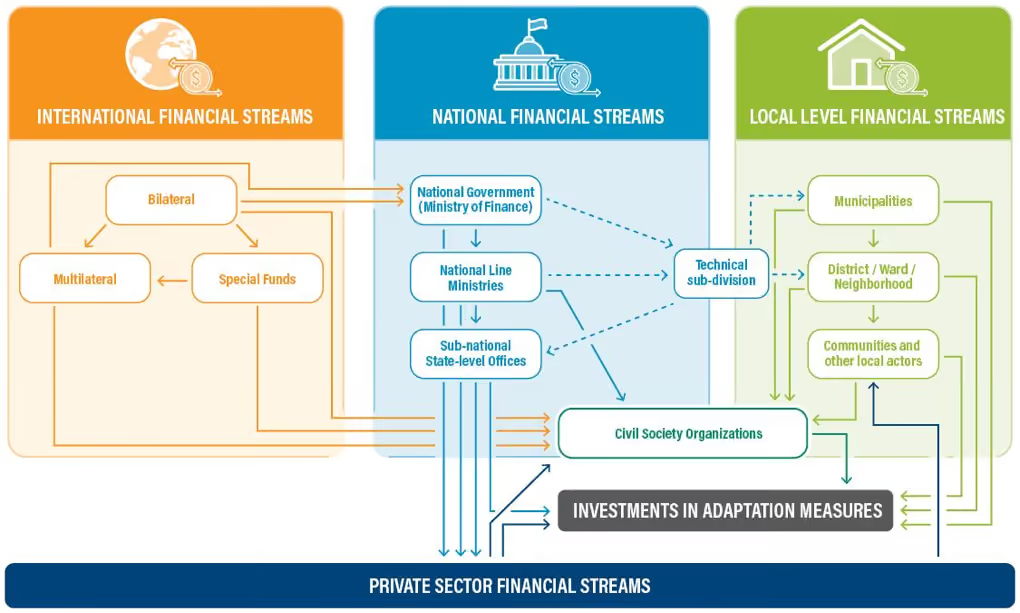
Figure 1. Adaptation finance can travel through several institutional layers before it reaches the level at which land, infrastructure and services are managed. The risk is not merely delay; each layer can change priorities, eligibility and the degree of local discretion.
The gap is between where climate risk is governed and where finance is governed
The most useful starting point is to separate three questions that are often collapsed into one: where money is committed, where money is allocated, and where decisions affecting adaptation outcomes are made.
A national government may be the formal recipient of an international climate facility while a provincial department, metropolitan authority or district administration is responsible for drainage, road maintenance, water security, settlement planning, agricultural extension or emergency response. A finance system can therefore be functioning exactly as designed while still producing weak local adaptation outcomes.
This is why the subnational question is more consequential than it first appears. It is about the institutional location of implementation, not simply the administrative location of a bank account.
The latest adaptation investment-planning literature reinforces this point. The research describes adaptation finance as requiring a systemic intervention that connects resilience strategies to programmatic investment pipelines, public financial management and investment management processes. Their work also stresses the roles subnational governments play as consumers, providers, fundraisers, regulators and convenors.
A major weakness in the current debate is the absence of a consistent distinction between direct access, indirect allocation and local implementation. These are not equivalent.
Table 1. 'Local delivery' should not be treated as synonymous with subnational access. The distinction matters for accountability and local decision-making.
Three barriers sit between climate finance and local action
Barrier 1: Accreditation and access architecture
Climate funds have fiduciary, safeguards and accreditation requirements for good reason. The problem is that the architecture can implicitly assume institutional capabilities that many subnational entities do not possess. The result is a paradox: the entity closest to the risk may be least able to satisfy the rules governing access.
The policy response should not be to remove fiduciary standards. It should be to create proportionate pathways into them. Staged accreditation, pooled accreditation, delegated authority under accountable intermediaries, and funded readiness programmes can preserve integrity while widening the set of institutions able to originate and govern investments.
The Burkina Faso readiness example is useful in this respect: readiness support can be used to strengthen institutional capability and create a pipeline before large-scale investment is expected. The lesson is that access capacity has to be built before finance is demanded, not after.
Barrier 2: Fiduciary capacity and the economics of small projects
A district may have a strong adaptation priority but no dedicated climate-finance team, project-preparation unit, credit history or investment-grade pipeline. A financier sees a small transaction with high due-diligence costs. The district sees an urgent public need. Both perspectives can be rational, yet the transaction does not happen.
This is one reason aggregation matters. Several municipalities can be brought into a common facility; projects can be bundled; standard documentation can reduce transaction costs; technical assistance can be shared; and national or development-bank platforms can provide credit enhancement.
The OECD's subnational climate-finance work similarly points to the importance of the enabling environment around subnational investment, including fiscal frameworks, institutional capacity and access to finance. The question is therefore not whether local governments are 'bankable' in the abstract, but what financial architecture can make priority investments financeable at an acceptable risk and cost.
Barrier 3: Programme design treats the national government as the end point
Many programmes are designed around national policy alignment, national reporting and national execution. That is understandable from a donor's perspective. But it can create a delivery blind spot if the programme stops asking how decisions are translated into local investment plans, budgets and procurement.
A better design asks four questions at approval stage: Which subnational institutions will make the investment decision? What resources will they control? What discretion will they have to adapt the programme to local risk? And what evidence will show that the resources reached the intended level?
What is already working: lessons from emerging models
Kenya's Subnational Climate Finance
Kenya's Subnational Climate Finance approach is important because it starts from a different premise: county governments are not merely delivery agents for national programmes; they can have defined roles in identifying and financing local climate priorities. The model combines national architecture with county-level planning and financing mechanisms, demonstrating how ring-fenced or dedicated facilities can connect climate finance to decentralised decision-making.
The broader lesson is institutional rather than numerical. A dedicated facility creates a recognised route for local priorities to enter the finance system, while also providing a framework through which capacity, fiduciary requirements and reporting can be standardised.
Rwanda's FONERWA / Rwanda Green Fund
Rwanda's experience illustrates the value of a national climate fund acting as an intermediary with a strong domestic institutional mandate. The fund can aggregate resources, manage fiduciary requirements and support investments that align with national priorities while engaging lower levels of government and local actors.
The lesson for subnational finance is that intermediary institutions can solve a real problem: they can provide the systems that smaller local entities do not have to build independently. But the governance question remains critical: intermediation should reduce transaction costs without removing local priority-setting.
Burkina Faso: readiness before scale
The Burkina Faso Green Growth / GCF readiness work highlights a different stage of the finance journey: institutional readiness. Readiness resources can help countries establish the systems, capacities and project pipelines required to make subsequent climate finance usable. For subnational adaptation, this principle is directly relevant. Local governments need investment planning, fiduciary support and project preparation before they can absorb larger flows.
This is also where the new Adaptation Investment Cycle is useful. Its six phases move from context and financing barriers through investment needs, project pipelines, matchmaking and learning. Early applications in London, Ithaca, Marche and Glasgow show how investment planning can reveal financing sources, political constraints and pipeline gaps that are invisible when adaptation is treated only as a list of projects.
Subnational borrowing and the city finance question
Cities with sufficiently strong fiscal and institutional systems can use municipal borrowing, green bonds, development-bank lending, guarantees and blended finance. Cape Town's green bond experience is an important African example of how a city can access capital-market finance for climate-relevant infrastructure when creditworthiness, governance and project pipelines are sufficiently developed.
The important caveat is that capital-market access is not a universal answer. It works best where own-source revenues, intergovernmental transfers, debt rules and creditworthiness support borrowing. For poorer districts, grants and concessional finance remain essential. A credible subnational architecture therefore needs a ladder of instruments rather than one preferred solution.
Figure 2. A more realistic subnational adaptation finance ladder
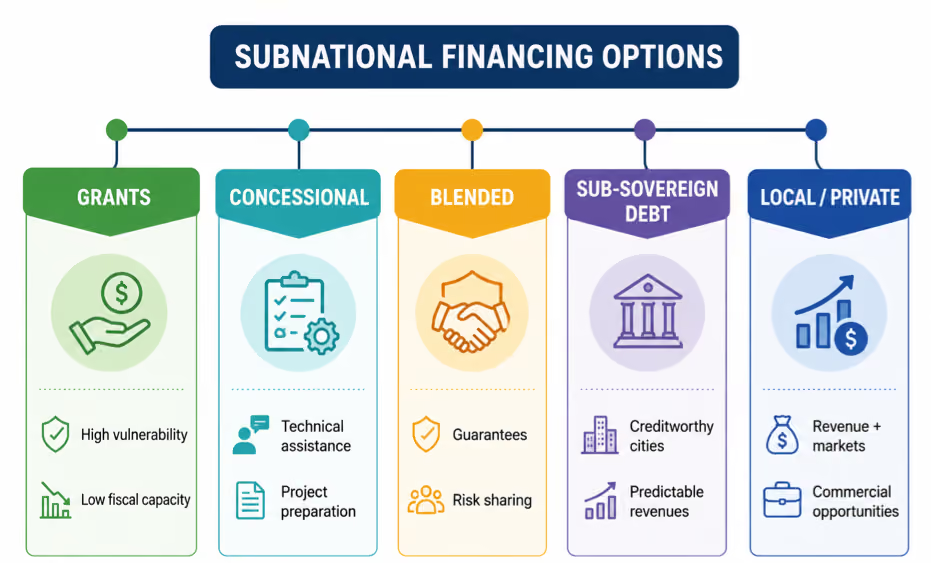
Figure 2. The financing instrument should follow fiscal capacity, risk, public-good characteristics and revenue potential. Adaptation finance is not one market.
The economics: why adaptation is hard to finance but easy to underfund
Adaptation has a financing problem that mitigation does not always share. A flood protection scheme, drainage network, heat action plan or water-resilience investment can create large social benefits without producing a cash flow that repays a private investor. This makes the economic case much stronger than the financial case.
England et al. make this distinction explicit: economic appraisal considers welfare and avoided costs, while financial analysis examines revenue and cash-flow potential. Both are needed because public investment can be economically valuable without being privately financeable.
That distinction should change how projects are presented. A municipal drainage programme should not be rejected because it does not produce a commercial return. Its relevant return may be avoided flood losses, protected economic activity, reduced disruption to public services, lower health costs and reduced future fiscal stress.
At the same time, where adaptation creates revenue or protects revenue-generating assets, financial instruments should be considered. The objective is not to privatise adaptation. It is to allocate financing responsibility according to who receives benefits, who can bear risk and where public intervention can crowd in additional capital.
Table 2. A practical screening test for adaptation investments
Subnational finance is also a climate-justice issue. A finance architecture can be formally neutral and still produce unequal outcomes if better-resourced municipalities have stronger project teams, better data, established relationships with development banks and greater ability to meet co-financing requirements.
The Adaptation Investment Cycle explicitly incorporates distributive and procedural justice across the investment process, including assessment of distributional impacts, selection of finance instruments and participation of those most affected.
For donors and national governments, this suggests a simple test: does the allocation mechanism compensate for differences in institutional capacity, or does it reward them? Competitive calls can be efficient for finding good projects but may systematically favour places that are already better equipped to prepare them.
What needs to change
For international climate funds and bilateral donors
- Create explicit subnational access windows, whether through direct accreditation, delegated authority or trusted intermediaries with enforceable local decision rights.
- Make capacity-building multi-year and tied to an investment pipeline, rather than treating readiness as a one-off training activity.
- Require programmes to report not only the national recipient but the level of government controlling the investment decision and the ultimate geographic allocation.
- Use proportionate fiduciary and reporting requirements for smaller transactions while preserving safeguards and auditability.
- Support pooled project-preparation facilities so that smaller municipalities can enter the finance system without carrying the full transaction cost individually.
For national governments
- Create transparent, climate-sensitive intergovernmental transfers linked to local risk and investment need.
- Give subnational governments a formal role in national adaptation finance allocation, rather than consultation after priorities have already been set.
- Integrate adaptation into public financial management and public investment management systems at both national and subnational levels.
- Clarify borrowing, guarantee and revenue rules so creditworthy subnational entities can access appropriate finance.
- Build national project-preparation platforms that local governments can use to develop bankable and economically justified pipelines.
For DFIs and sub-sovereign lenders
- Treat sub-sovereign finance as a portfolio proposition: aggregate municipalities, standardise documentation and reduce transaction costs.
- Expand guarantees, local-currency instruments and concessional windows where currency and credit risks prevent viable investment.
- Assess institutional improvement alongside credit metrics; a technically weak municipality may become financeable when supported by a credible programme and intermediary.
- Use blended finance selectively to solve specific risk or affordability constraints rather than as a label applied to every adaptation project.
From project lists to investment systems
The most important conceptual shift is from 'funding projects' to 'building an investment system'. Recent adaptation investment planning research provides a useful model: define the context; map financing barriers; quantify and prioritise investment needs; build a pipeline; match projects with finance; then monitor, report and learn.
This approach also exposes a limitation in many climate-finance discussions. A project pipeline is not bankability. A list of proposed projects becomes investable only when costs, benefits, risk allocation, governance, procurement, revenue or public-value rationale, implementation capacity and financing structure have been worked through.
Glasgow's experience is instructive. The adaptation investment work helped mobilise additional capacity-building resources and develop innovative financing approaches, but the evaluation also identified gaps in later-stage matchmaking and finance-related monitoring.
That is precisely why the final stages matter. Finance mobilisation is not complete when a project is identified. The system needs to carry the project through structuring, execution and learning.
Table 3. The subnational indicators that should be reported
Conclusion
The adaptation finance gap is often expressed as a number. The more consequential gap is institutional: the distance between the institution receiving finance and the institution responsible for making adaptation real.
Subnational governments should not be treated as the final administrative step in a national climate programme. In many contexts they are the operational centre of adaptation. They decide where development occurs, what infrastructure is maintained, how water is managed, how emergencies are handled and which communities receive public protection.
The answer is not to bypass national governments. National governments remain essential for fiscal policy, sovereign borrowing, national planning and international climate-finance relationships. The answer is to redesign the chain so national systems deliberately empower the subnational institutions that must deliver.
COP31 should therefore move the adaptation finance conversation beyond the volume of money committed. Every major adaptation finance commitment should be accompanied by a delivery architecture that can answer: how much reaches subnational decision-makers, through which mechanism, with what discretion, in how many high-risk jurisdictions, and with what evidence of results.
If that cannot be answered, tripling finance may produce a larger number without producing a proportionate increase in resilience.
References and further reading
OECD (2023). Subnational Climate Finance Hub Compendium and Analysis. OECD Centre for Entrepreneurship, SMEs, Regions and Cities. View publication
Regions4 (2025). Financing Adaptation: Where Change Happens Scaling Subnational Action to Close the Gap. Regions4 / RegionsAdapt. View publication
Climate Policy Initiative (2024). Subnational Climate Fund: Africa Adaptation Finance case study. View case study
UNDP Asia-Pacific (2024). Adaptation Finance Strategy Guideline. View guideline
NAP Global Network (2024). Guiding Principles for Financing Strategies for Adaptation. View guidance
World Bank (2021). The Role of Subnational Governments in Combating Climate Change. Read article
Green Climate Fund (2022). Burkina Faso: Readiness / Green Growth and related country programme documentation. View document
UNCDF (2023). Local Climate Adaptive Living Facility / local adaptation finance materials. View materials
Filatova, T., Taberna, A., Chatzivasileiadis, T., Cortés Arbués, I. (2025). Private sector investments in climate change adaptation. Nature Climate Change, 15, 1249–1256. View article
Brullo, T., Barnett, J., Waters, E., & Boulter, S. (2024). The enablers of adaptation: a systematic review. npj Climate Action, 3, 40. View article
Haasnoot, M., van Aalst, M., Rozenberg, J., et al. (2020). Investments under non-stationarity: economic evaluation of adaptation pathways. Climatic Change, 161, 451–463. View article
Gilmore, E.A., Kousky, C., & St. Clair, T. (2022). Climate change will increase local government fiscal stress in the United States. Nature Climate Change, 12, 216–218. View article
Bisaro, A. & Hinkel, J. (2018). Mobilizing private finance for coastal adaptation: a literature review. Wiley Interdisciplinary Reviews: Climate Change, 9(3), e514. View article
European Environment Agency (2022). Towards ‘Just Resilience’: Leaving No One Behind When Adapting to Climate Change. View publication
Climate Ready Clyde (2021). Glasgow City Region Adaptation Strategy and Action Plan 2020–2030. View strategy
UNFCCC (2023). National Adaptation Plan Progress Report / related adaptation finance evidence. View document