



Executive Proposition
The Global South does not face a simple shortage of capital. It faces a mismatch between the scale, currency, risk, tenor, and public-purpose characteristics of infrastructure investment and the forms of finance currently available.
Countries need more power, transport, water, digital networks, urban systems, and climate-resilient infrastructure at precisely the moment when public budgets are constrained, external borrowing is expensive, and international investors remain selective about emerging-market risk. In 2024, low- and middle-income countries received USD 100 billion in private participation in infrastructure, a 20 per cent increase from the five-year average of USD 83.7 billion. Yet the OECD estimates global infrastructure needs at USD 6.9 trillion annually through 2030, with developing countries facing the widest deficits. The gap between USD 100 billion and USD 6.9 trillion is not primarily a supply problem. It is an architecture problem.
The headline problem is described as a financing gap. The deeper problem is a mismatch between projects that are socially and economically transformative and financial instruments that investors can hold at acceptable risk and return.
The strategic response must therefore be broader than attracting more foreign private capital. International private finance remains essential, but it must be matched to the risks and assets it can genuinely price. Public institutions need to perform the functions markets cannot perform efficiently: long-term planning, project preparation, local-currency intermediation, risk pooling, public-good investment, and counter-cyclical finance. The architecture question is not who provides the capital. It is whether the financial system can keep savings, risk-bearing capacity, and long-term investment connected to development at home.
1. The Gap Is Measured in Trillions, But the Market Is Not Empty
The infrastructure and SDG investment gap in developing countries is measured in trillions. UNCTAD estimates the annual SDG investment gap at USD 4 trillion, up from USD 2.5 trillion before the COVID-19 pandemic. Volz, Lo and Mishra (2024) at the SOAS Centre for Sustainable Finance estimate that EMDEs excluding China require USD 2–2.8 trillion annually by 2030 for climate-related investment alone, with approximately USD 1 trillion of that requiring external finance. These are not financing requests. They are orders of magnitude that the entire conventional development finance architecture, ODA, MDB lending, blended finance cannot meet on its own.
What makes the picture structurally interesting is not only the size of the gap but its composition. Volz, Lo and Mishra document that EMDEs excluding China accumulated USD 15.5 trillion in foreign asset and reserve acquisitions between 2004 and 2023, USD 11.8 trillion in net foreign assets acquired by residents and USD 3.7 trillion in reserve accumulation. These are developing country savings invested abroad, largely in hard-currency assets in advanced financial centres, rather than in domestic productive investment. In Cambodia, average annual foreign and reserve asset acquisitions over the last two decades amount to 7.5 per cent of GDP nearly equal to the IMF’s estimate of Cambodia’s annual SDG financing gap of 8.1 per cent of GDP. Capital scarcity and domestic investment scarcity coexist. The challenge is not to find more capital. It is to connect existing capital to productive domestic investment through institutions and instruments capable of intermediating it.
2. Why ‘Billions to Trillions’ Has Not Solved the Problem
The premise of 'billions to trillions' is that a modest amount of public capital can catalyse a multiple of private infrastructure investment across the Global South. Arun (2024) at the Carnegie Endowment examines this premise through the lens of the G7 Partnership for Global Infrastructure and Investment, which has committed to mobilise USD 600 billion by 2027. Against that target, the White House claimed to have mobilised USD 60 billion as of late 2024, ten per cent of the goal, over three years of a four-year commitment period. This is not an execution failure. It is a structural one.
Private institutional investors, pension funds, insurance companies, infrastructure funds, have hurdle rates that are independent of broader economic conditions and of any individual project’s risk-adjusted return profile. Volz, Lo and Mishra report infrastructure-fund hurdle rates around eight per cent across regions and sectors. Many development projects generate local-currency returns or no direct cash flow. Projects with decent return profiles, positive debt service coverage ratios, and appropriate risk structures may still never secure private investment, not because they are bad projects, but because they do not meet the portfolio optimisation requirements of institutions whose fiduciary duty is to their own investors. Additionally, private infrastructure funds saw a 95 per cent year-on-year drop in capital raised in 2023, and blended finance transaction volumes fell to a ten-year low. The capital exists. The willingness to deploy it across most of the Global South does not.
The mobilisation ratios tell the same story. Volz, Lo and Mishra report an average MDB mobilisation ratio of approximately USD 0.60 of private capital for every USD 1 of MDB lending, and estimate that private climate finance per public dollar spent on climate may be as low as USD 0.30. These figures vary by instrument, country, sector, and methodology, they are not universal benchmarks. But they do challenge the assumption that a small public contribution mechanically produces a multiple of private investment at scale. The more fundamental constraint is project suitability. A water network with high development value but no foreign-currency revenue stream is not a bankable project for an international infrastructure fund, regardless of how many de-risking instruments are layered on top of it.
Bankability is not an intrinsic property of a project. It is produced by a financial, regulatory, and contractual structure. The relevant question is whether making a project bankable creates economic value or merely converts public obligations into an investable security.
3. The Overlooked Asset: Domestic Savings
The infrastructure finance debate typically begins with the question: how do we attract more foreign capital? The more productive question is: how do we connect domestic savings to domestic investment? Volz, Lo and Mishra’s USD 15.5 trillion estimate is important precisely because it makes visible a structural irony: developing countries are capital exporters. Savings leave in the form of hard-currency reserve accumulation and private capital flight. Some returns in the form of high-yielding, short-term debt increasing financial vulnerabilities rather than financing infrastructure.
Pension funds need long-duration assets. Insurers need predictable cashflow instruments. Households need credible savings products. Banks need suitable assets. Development banks need balance sheets capable of originating and aggregating projects. These are not separate problems. They are components of a single financial architecture that developing countries need to build simultaneously. Local-currency finance is especially important within this architecture. A project whose revenues are in local currency but whose debt is denominated in dollars creates an asset-liability mismatch that looks manageable at financial close and can become catastrophic after exchange-rate depreciation. The currency risk ultimately sits somewhere: with users through higher tariffs, with government through contingent support, or with investors through lower returns. Pricing that risk transparently and allocating it appropriately is a financial architecture problem, not a project-level one.
The East Asian experience is instructive. Singapore’s Central Provident Fund channels household savings into domestic housing and infrastructure through a structured financial system that connects individual saving to national investment needs. Malaysia and South Korea have both demonstrated that developing local currency bond markets requiring credible fiscal and monetary institutions, predictable regulation, disclosure systems, and a broad investor base creates the foundation for long-term infrastructure finance that does not depend on foreign-currency borrowing. Volz, Lo and Mishra document that the ASEAN local currency bond market, measured as a share of GDP, grew substantially in countries that invested in the enabling architecture. Infrastructure finance should therefore be treated as part of financial-sector development, not as a sequence of isolated project transactions.
4. National Development Banks
The strongest response to the false choice between state finance and private finance is better intermediation. National development banks occupy a position between public policy and capital markets that no other institution can fill: they can originate projects, aggregate smaller investments, lend in local currency, provide credit enhancement, and issue bonds that domestic institutional investors can hold. Volz, Lo and Mishra make the case for NDBs as the central institution of a domestic financial architecture for sustainable investment with MDB and DFI equity, guarantees, and technical support expanding their capacity rather than substituting for it.
The Development Bank of Rwanda provides a recent and replicable example. An IDA first-loss guarantee supported a local-currency sustainability-linked bond issued by the bank, helping it diversify its funding base away from reliance on international DFI finance and contributing to Rwanda’s local capital market development. The significance is systemic rather than transactional: concessional international capital strengthened a domestic intermediary that then connects larger pools of local savings to investment. This is closer to financial-system development than conventional project de-risking. It builds an institution capable of financing many projects, rather than subsidising one transaction at a time.
The model is replicable. Mohan and Srinivasan (2026) draw on India’s experience of establishing the National Bank for Financing Infrastructure and Development in 2021 to make a comparable argument: national institutions with a clear development mandate, proper capitalisation, and long-term lending capacity are the missing link between policy ambition and project delivery. The Development Bank of Nigeria modelled on Germany’s KfW and established with equity from the European Investment Bank and the African Development Bank, and the Development Bank of Ghana, supported by the World Bank Group, the AfDB, and the EIB, are further examples of the MDB-NDB partnership model in practice.
NDBs face a sovereign ceiling constraint that currently limits their capacity: as fully government-owned institutions, their credit risk cannot exceed that of their sovereign, constraining their cost of capital and lending capacity. MDB equity injections or callable capital commitments would not only strengthen the NDB’s balance sheet but would signal to capital markets the governance standards and oversight that justify better refinancing terms. Volz, Lo and Mishra also highlight the potential of digital and tokenised instruments retail bonds purchased via mobile phone, tokenised sustainability-linked bonds targeted at diaspora investors, DLT-based bond platforms to broaden the investor base and reduce transaction costs for domestic capital mobilisation.
5. MDBs Should Move from Transaction Support to Financial Architecture
MDB reform is typically discussed in terms of balance sheet capacity: how much additional lending can be generated from existing equity. For infrastructure, the more consequential question is what financial system those balance sheets can help create. MDBs possess comparative advantages that individual developing countries often lack: diversified portfolios, strong credit ratings, long maturities, and the capacity to pool risks across jurisdictions and sectors. Those advantages can be used to extend local-currency finance, strengthen NDBs, support project preparation facilities, provide guarantees, and create investment vehicles that meet institutional-investor requirements.
The contrast Volz, Lo and Mishra draw is instructive: MDBs are among the largest climate finance providers to low- and middle-income economies, having reached a record USD 85 billion in 2024. Yet international private climate finance reaching EMDEs averaged only approximately USD 15 billion annually in 2021/22. The mobilisation gap is not primarily a pricing or de-risking problem. It is a market structure problem. MDB balance sheets should be used to change the structure creating local-currency assets, strengthening NDB intermediaries, and building the project pipelines and preparation capacity that determine whether committed capital becomes construction.
Private capital remains indispensable for commercially viable assets where risks can be contracted, revenues are predictable, and governance is credible. But governments and public financial institutions must retain responsibility for investments where social returns exceed private returns, where risks cannot be priced efficiently in private markets, or where the time horizons required exceed what private investors can hold. The objective is complementarity, not substitution. Arun (2024) names this directly: programmes that rely on mobilising private capital toward vaguely defined 'sustainable infrastructure,' while neglecting to build state capacity to coordinate investment and development, amount to an industrial policy failure. What PGI portends its promises and pitfalls is already visible in the Lobito Corridor, where USD 1.3 billion in DFC and EXIM financing supports a rail corridor whose long-term sustainability depends on Angolan state capacity that no private investment instrument can supply.
6. Africa Makes the Structural Constraint Particularly Visible
Africa’s infrastructure finance challenge combines several structural constraints that, taken together, explain why the continent attracts less infrastructure investment than its development needs require and its economic fundamentals might warrant. Understanding those constraints specifically rather than treating them as a generalised 'risk' is a precondition for addressing them.
The UCL Bartlett Development Planning Unit (2025) identifies five themes in sustainable infrastructure financing for Africa: the role of public finance as enabler rather than substitute, the importance of domestic resource mobilisation alongside external capital, the need for regulatory reform to create bankable project environments, the underutilisation of regional economic communities as financing coordination platforms, and the gap between infrastructure investment volumes and maintenance spending. SAIIA (2024) reinforces the finding that Africa’s 54-state infrastructure financing challenge is not uniform: some countries have made significant progress on regulatory reform and domestic capital market development while others face more fundamental fiscal and governance constraints. Treating Africa as a single infrastructure finance problem is analytically imprecise and strategically counterproductive.
The Africa-Europe Foundation / NEPAD Technical Paper and Standard Bank CIB’s energy and infrastructure analysis both point to a consistent finding: the most valuable external capital for African infrastructure is not capital that fills the funding requirement of an already bankable project. It is capital that reduces the structural constraints, currency, tenor, preparation, creditworthiness, and market depth that prevent projects from becoming bankable in the first place. The investable pipeline has to be built inside countries and regional markets. It cannot be imported.
7. The Pacepoint Infrastructure Finance Architecture Test
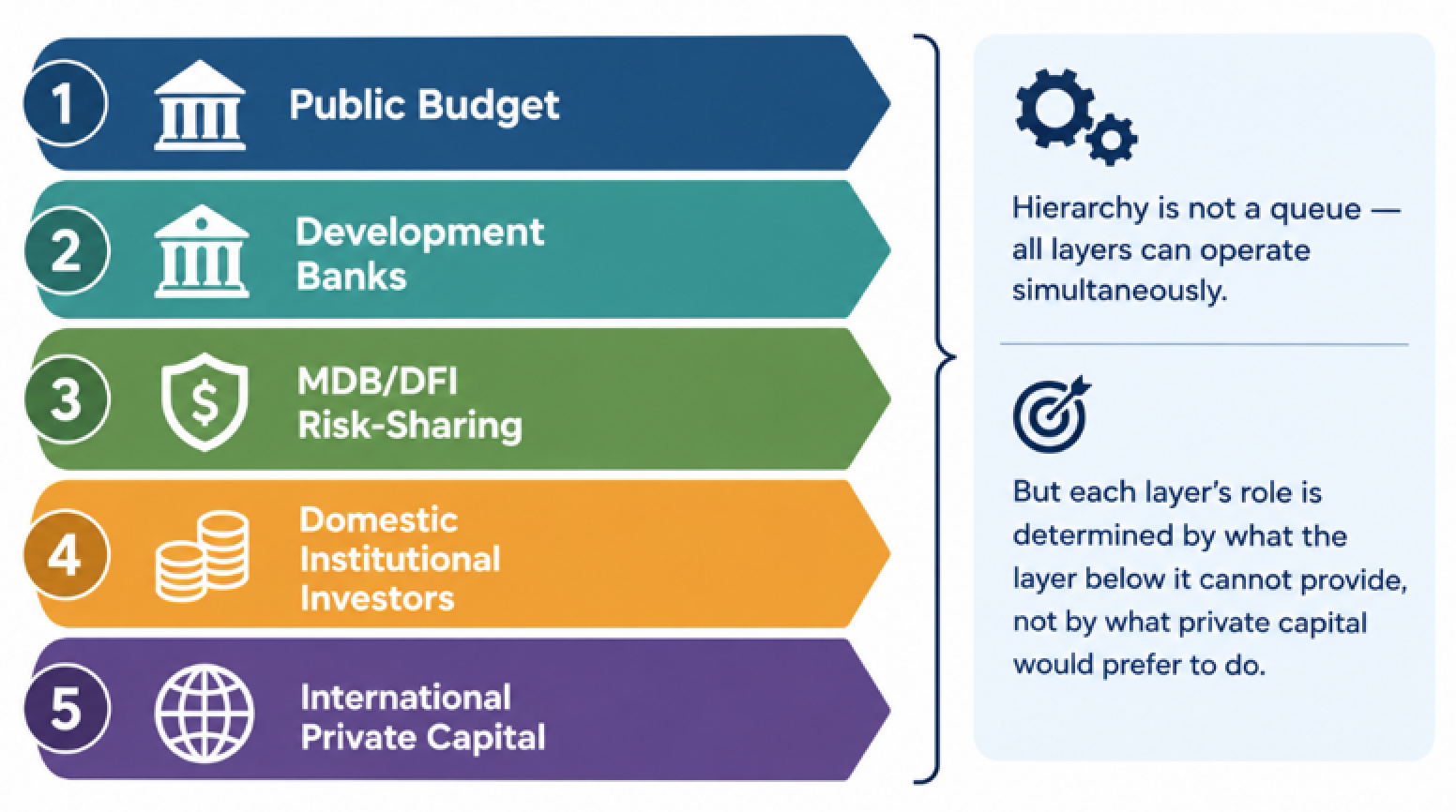
Before a government asks whether a project can attract private finance, it should ask whether the financial architecture is appropriate to the asset, the country, and the public objective. The following five-question test structures that decision. It applies before financial advisers are engaged, before procurement strategy is chosen, and before any instrument is selected.
8. What Decision-Makers Should Do Differently
The strategic shift required is not from public finance to private finance, or from private finance to public finance. It is from a transaction-first approach in which each project seeks the financing model that happens to be available to an architecture-first approach, in which the financial system is built to match the range of assets, currencies, maturities, and risk profiles that development infrastructure requires.
Conclusion
The Global South does not need a larger version of yesterday’s infrastructure finance model. It needs a different one. Investment requirements are measured in trillions; international private capital reaching development and climate projects remains far smaller than mobilisation rhetoric implies; large pools of developing country savings are invested abroad; local-currency markets remain shallow in many countries; and development banks have underused potential as intermediaries. Arun (2024) and Mohan and Srinivasan (2026) reach the same conclusion from different directions: without institutional capacity, domestic financial depth, and credible regulatory frameworks, every additional unit of private capital mobilisation will produce less infrastructure than the headline numbers imply.
The strategic answer is not to choose between the state and the market. It is to build institutions that allow them to work together without confusing their roles. Governments should finance what markets cannot efficiently finance. Development banks should build pipelines and create investable domestic assets. MDBs should use their balance sheets to solve currency, tenor, credit, and market-depth constraints. Private investors should finance risks they can genuinely price and manage. Regulators should protect service quality and affordability over the life of the asset, not just at the point of financing.
The measure of success should not be the headline amount of private capital ‘mobilised’. It should be whether countries can build more infrastructure, in local and affordable terms, with stronger domestic financial systems and less dependence on short-term or foreign-currency financing. That is the infrastructure finance test for the next decade: not how much money can be attracted into the Global South, but whether the financial architecture can keep savings, risk-bearing capacity, and long-term investment connected to development at home.


.avif)