
Technology leadership is strategic leadership. Full stop.
Yet in too many organizations, CIOs remain trapped in an operational box, managing uptime, approving vendor contracts, explaining why projects are late. Meanwhile, boards demand digital transformation. CFOs expect measurable business value from technology spend. CEOs need technology to drive growth, not just enable it. The gap between what organizations require from technology leaders and how they treat them has never been wider.
The role has fundamentally changed. Organizations that fail to recognize this are already behind.
The CIO Role Has Changed, Many Organizations Have Not
CIOs now operate in an environment where technology shapes competitive advantage more than capital, talent, or geographic positioning. An analysis demonstrated that the CIO Agenda shows 94% of technology leaders expect major strategic shifts within 24 months, yet only 48% of digital initiatives meet business targets (Gartner, 2025). The problem is not ambition, it is misalignment between how organizations treat technology and what technology now determines.
Boards still measure CIOs on system reliability and project delivery while expecting them to explain how AI will reshape the business model. CFOs approve technology budgets based on cost optimization while demanding revenue growth from digital channels. McKinsey research confirms less than half of technology leaders believe their organizations have been effective in leading digital client experience not because CIOs lack capability, but because they lack authority to shape strategy, only to implement it (McKinsey, 2021).
The structural problem is clear: CIOs are asked to deliver strategic outcomes without strategic authority. They are expected to co-create business value while operating within a service delivery mindset. When technology drives competitive differentiation: AI, data monetization, platform business models, customer experience, relegating the CIO to infrastructure management is organizational self-sabotage.
What Strategy Co-Pilots Actually Do
The organizations winning with technology have redefined what CIOs do. Not incrementally, fundamentally. These technology leaders operate as strategy co-pilots: co-owners of enterprise direction, not executors of someone else's vision.
Co-Own Enterprise Strategy with CEO and Board
Digital vanguard CIOs meet with business executives four times more frequently than their peers and dedicate 35% of business staff to technology work versus 21% elsewhere (Gartner, 2025). This is not collaboration theater, it is shared accountability for business outcomes. In a financial services firm, the CIO shaped acquisition strategy by leading technical due diligence, running pilot integrations, and determining whether vendor capabilities could deliver on business promises (McKinsey, 2020). The board now expects the CIO to present on technology-enabled business models because technology is the business model.
Translate Technology Investment into Measurable Business Value
Analog Devices CIO Nancy Avila frames this bluntly: if technology is not driving value for shareholders, employees, or customers, it is just adding cost (McKinsey, 2025). Leading CIOs implement portfolio management processes that assess every technology initiative against business goals, not technical completion. They price technical debt against business opportunity cost. They demonstrate that cloud migration delivers not infrastructure efficiency but product development acceleration and new revenue channels, 75% of cloud value comes from growth, not cost reduction (McKinsey, 2021).
Design Decision-Enabling Tech Architectures, Not Tool Sprawl
Starbucks previous CTO Deb Hall Lefevre captured this precisely: architecture is strategy for modern businesses (McKinsey, 2025). CIOs operating as strategy co-pilots design technology foundations that enable business agility, not systems that require months to change. They build platforms that empower business teams to innovate without waiting for IT. McKinsey research shows top performers use end-to-end product teams at scale, allocating employees to business outcome delivery rather than maintaining traditional functional silos (BCG, 2024).
Lead Risk, Resilience, and Digital Governance
Boards now demand technology sovereignty and digital autonomy while pushing rapid innovation (McKinsey, 2025). CIOs must navigate geopolitical risk, data sovereignty requirements, and vendor dependencies while capturing AI benefits. Gartner finds 32% of non-US CIOs are intentionally shifting toward regional vendors driven by geopolitical factors, technology sourcing has become strategic risk management, not procurement optimization (Gartner, 2025). Effective CIOs treat governance as competitive advantage: compliance from day one, no exceptions, no manual workarounds, enabling speed through clarity rather than blocking progress through bureaucracy.
Build Organizational Capability, Not Dependency
The most financially successful companies treat technology transformation differently: they build internal capability systematically (McKinsey, 2024). Leading CIOs create enterprise-wide upskilling programs, online learning portals, expert networks, and psychological safety that empowers developers to raise issues quickly, the number one enabler of technology impact on business performance (McKinsey, 2021). They use best developers for most important work, not basic mechanical tasks. They recognize talent strategy determines whether organizations can execute digital strategy.
What Organizations Must Stop Doing, And Start Doing
Organizations serious about winning with technology must make uncomfortable changes.

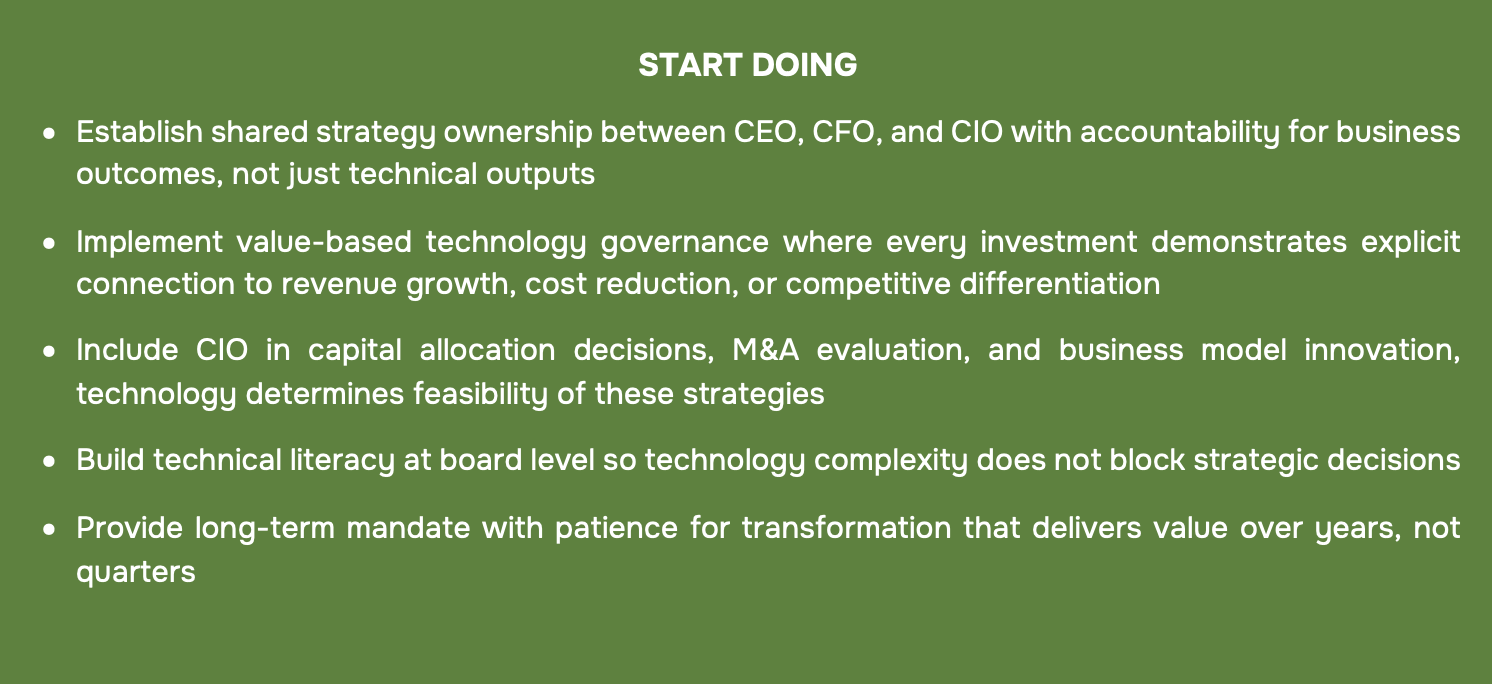
The shift from service delivery to strategic co-ownership requires CEOs and boards to change how they engage CIOs. McKinsey research shows three-quarters of organizations fail to provide the long-term mandate, aligned priorities, and technical literacy that CIOs need to transform IT into strategic capability (McKinsey, 2021). This failure costs more than delayed projects, it costs competitive position.
Application of this Shift
At Pacepoint, we do not run technology assessments and hand over recommendations. We embed with leadership teams to architect the CIO-CEO-CFO operating model from the ground up. Specifically, we:
Map decision authority across the technology-business boundary, documenting precisely which technology decisions require business leader approval versus CIO autonomy, eliminating the ambiguity that stalls execution. We create decision rights matrices that boards can operationalize immediately, not frameworks that sit in slide decks.
Design value realization frameworks tied to capital allocation, working with CFOs to restructure technology budgeting from cost centers to investment portfolios, where every dollar has an explicit business outcome owner and quarterly value checkpoints. We build the measurement infrastructure that proves technology ROI, not just reports it.
Establish CIO-Board governance cadences, creating quarterly strategic review formats where CIOs present business strategy implications of technology choices (AI risk, platform dependencies, data monetization opportunities) rather than project status updates. We prepare boards to ask the right questions and CIOs to answer in business language.
Co-develop technology talent strategies with CHRO and CIO, because capability determines execution. We design upskilling programs, role redesigns, and incentive structures that shift technology teams from order-takers to business problem-solvers. This is how organizations reduce vendor dependency while accelerating delivery.
Run executive war games on technology-driven disruption scenarios, where CEO, CFO, CIO, and business leaders simulate competitor moves, regulatory changes, and technology shocks. These sessions surface misalignment fast and build the muscle memory for rapid strategic technology decisions.
What differentiates Pacepoint: we stay engaged through implementation, not just design. Our success is measured when CIOs gain board seats, when technology investments show up in earnings calls as growth drivers, when business leaders stop asking "what will IT build" and start asking "how should we architect this capability together."
Organizations that still treat the CIO as a system custodian are already behind. The question is not whether the role will change, but whether leadership will.
Technology leadership is strategic leadership. Organizations that recognize this win. Those that do not are already losing to competitors who did.
References
- Boston Consulting Group. (2024, January 10). Speed, value, and the power of the innovation flywheel. Retrieved from https://www.bcg.com/publications/2024/speed-value-and-the-power-of-the-innovation-flywheel
- Gartner. (2025, November 25). The CIO agenda 2026: Master agility, risk and tenacity. Retrieved from https://www.gartner.com/en/articles/cio-agenda
- Gartner. (2025, October 23). LIVE from Gartner: A glimpse into the 2026 CIO agenda. The National CIO Review. Retrieved from https://nationalcioreview.com/articles-insights/live-from-gartner-it-sym-a-glimpse-into-the-2026-cio-agenda/
- McKinsey & Company. (2020, January 27). The CIO challenge: Modern business needs a new kind of tech leader. Retrieved from https://www.mckinsey.com/capabilities/mckinsey-digital/our-insights/the-cio-challenge-modern-business-needs-a-new-kind-of-tech-leader
- McKinsey & Company. (2021, December 1). What CIOs need from their CEOs and boards to make IT digital ready. Retrieved from https://www.mckinsey.com/capabilities/mckinsey-digital/our-insights/what-cios-need-from-their-ceos-and-boards-to-make-it-digital-ready
- McKinsey & Company. (2021, November 1). The CIO agenda for the next 12 months: Six make-or-break priorities. Retrieved from https://www.mckinsey.com/capabilities/mckinsey-digital/our-insights/the-cio-agenda-for-the-next-12-months-six-make-or-break-priorities
- McKinsey & Company. (2024, September 11). A new dawn for the technology officer. Retrieved from https://www.mckinsey.com/capabilities/tech-and-ai/our-insights/a-new-dawn-for-the-technology-officer
- McKinsey & Company. (2025, June 18). Show me the value: A CIO view on how tech can shape the business. Retrieved from https://www.mckinsey.com/capabilities/tech-and-ai/our-insights/show-me-the-value-a-cio-view-on-how-tech-can-shape-the-business
- McKinsey & Company. (2025, November 19). Boards are calling for more digital autonomy: How CIOs can deliver. Retrieved from https://www.mckinsey.com/capabilities/tech-and-ai/our-insights/boards-are-calling-for-more-digital-autonomy-how-cios-can-deliver