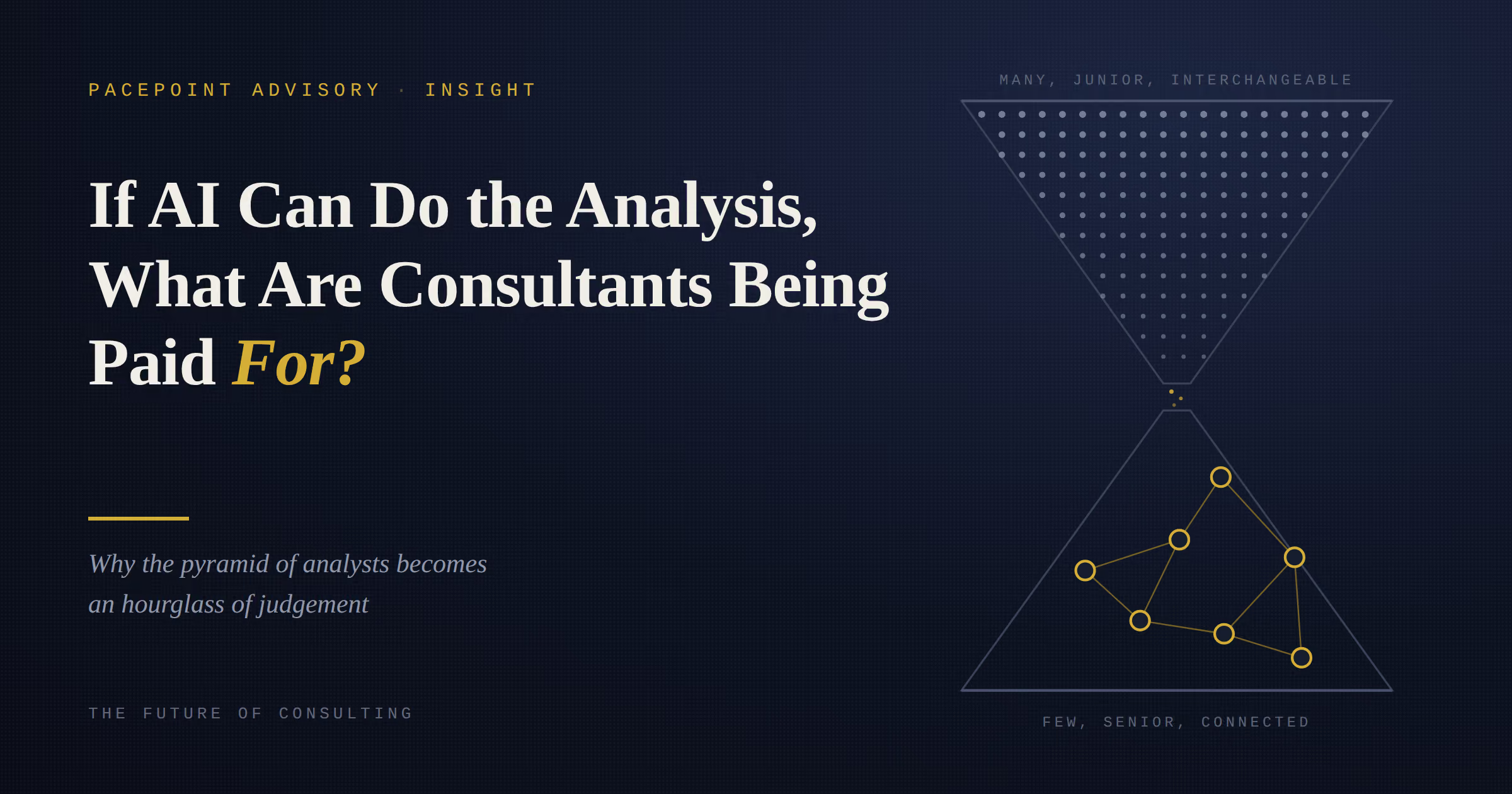

For three decades, enterprises optimized for efficiency, scale, cost reduction, and just-in-time delivery. That economic model is breaking. Measures of global uncertainty have nearly doubled since the mid-1990s, driven by geopolitical fragmentation, AI disruption, supply chain volatility, and regulatory divergence (McKinsey, 2025). The next generation of competitive advantage will not come from size alone. It will come from resilience architecture, the ability to absorb disruption while maintaining execution velocity, governance clarity, and strategic adaptability. Resilience is no longer risk management. It is economic strategy.
The Global Economic Model Has Changed
The operating environment that shaped enterprise strategy for the past thirty years has fundamentally shifted. Since 2017, US-China tariffs have increased sixfold, and global trade interventions have grown twelvefold since 2010 (McKinsey, 2025). More than 60 countries representing nearly 50 percent of the global population held national elections in 2024, creating political uncertainty across major economies (McKinsey, 2024). Business leaders now view geopolitics as the top risk to global growth, with political transitions ranking as the leading emergent threat.
This is not temporary volatility, it is structural fragmentation. The International Monetary Fund reports that increases in geopolitical distance between nations correlate with reduced cross-border investment (IMF, 2023). Since 2015, direct investment in China and Russia from advanced economies has dropped precipitously (McKinsey Global Institute, 2024). Capital flows now reflect geopolitical alignment rather than pure economic opportunity.
The End of Hyper-Efficiency Economics
The efficiency-first operating model that dominated globalization rested on assumptions that no longer hold: stable supply chains, predictable regulatory environments, accessible capital, and centralized manufacturing. Organizations designed systems for maximum cost optimization with minimal adaptive capacity. McKinsey simulations show that automotive companies exposed to global trade disruptions face 40 to 60 percent reductions in enterprise value under severe fragmentation scenarios (McKinsey, 2023). These are not stress test projections, they are live operational realities for multinationals operating across fragmented regulatory zones.
The World Economic Forum's 2025 Resilience Pulse Check reveals that mentions of "resilience" in Fortune 500 quarterly earnings calls surged over 200 percent compared to 2019 (WEF, 2025). Executives are not discussing resilience as aspiration, they are reporting it as operational imperative. The survey identifies technology risks, regulatory changes, macroeconomic volatility, and geopolitical instability as the top four threats creating major disruption for organizations (WEF, 2025). These factors operate simultaneously, compounding exposure rather than presenting isolated challenges.
Capital Pressure and Economic Uncertainty
Rising capital costs have fundamentally altered investment discipline. Boards now demand resilience-adjusted performance metrics, not just revenue growth. Companies must demonstrate that expansion strategies account for operational continuity under stress, regulatory compliance across divergent jurisdictions, and supply chain stability amid geopolitical friction. This requires answering questions that efficiency-era models never considered: Can operations continue if primary manufacturing regions become inaccessible? Does technology infrastructure function under data sovereignty constraints? Will capital markets fund growth that lacks structural resilience?
Organizations optimized exclusively for cost efficiency discover that their competitive advantages are brittle. When disruption hits, whether supply chain interruption, cyber breach, or regulatory shift, recovery costs exceed the accumulated efficiency gains. The companies capturing premium valuations are those demonstrating operational resilience alongside financial performance.
Why Traditional Enterprise Operating Models Are Failing
Many organizations invested heavily in digital transformation, cloud migration, AI experimentation, and ESG reporting, yet remain structurally unprepared for the fragmented operating environment. The gap is not ambition. It is execution architecture.
Technology Without Operating Model Alignment
McKinsey research shows that IT operating models and policies were not designed for the current level of volatility, leaving organizations exposed to sudden disruptions (McKinsey, 2026). Companies deployed enterprise technology platforms without redesigning workflows, decision rights, or accountability structures around those platforms. Result: increased system complexity without corresponding gains in organizational agility. Teams can access real-time data but lack authority to act on it. Dashboards proliferate while decision velocity stagnates.
Technology creates resilience only when integrated into operating models that enable rapid response. Predictive analytics means nothing if governance structures require weeks to approve course corrections. AI-powered insights do not translate to competitive advantage when execution depends on approval chains designed for a slower era. Organizations that treated digital transformation as a technology project rather than an operating model redesign now face compounding fragility, more systems to manage, higher complexity costs, and no corresponding improvement in adaptive capacity.
Governance Latency
Many enterprises do not lack strategy. They lack execution coherence. Boards approve ambitious resilience plans. Strategy teams produce comprehensive risk assessments. Yet when disruption occurs, organizational response remains slow, fragmented, and reactive. The structural problem: too many approval layers, disconnected leadership teams, fragmented accountability, and governance cadences mismatched to the speed at which operating reality changes.
The World Economic Forum's Global Lighthouse Network identifies that transformation is not a destination but a capability, one that turns volatility into advantage (WEF, 2026). Organizations achieving this capability have fundamentally redesigned governance for decision velocity. They empower cross-functional teams with clear authority, establish real-time performance visibility, and build feedback loops that surface operational constraints before they become strategic failures.
Traditional governance was designed for stable environments where annual planning cycles made sense and quarterly reviews provided sufficient oversight. That model breaks when geopolitical shifts occur monthly, regulatory changes emerge weekly, and operational disruptions require real-time response. Governance agility means embedding decision authority at the execution level, not escalating every material choice to executive committees that meet monthly.
Supply Chain and Operational Blind Spots
While reshaping supply chain footprints can segment geopolitical risk, it comes with significant costs and complexity. Organizations struggle to replicate supplier networks in new markets due to labor shortages, infrastructure constraints, and established ecosystem dependencies. Yet visibility into where critical assets, data, and talent are exposed in fragmented geopolitical environments remains a persistent blind spot for technology leaders (McKinsey, 2026).
The challenge is not just geographic diversification, it is operational intelligence. Do organizations know in real-time which suppliers face regulatory risk in which jurisdictions? Can they model how tariff changes in one region cascade through multi-tier supply networks? Have they stress-tested operational continuity when primary logistics corridors become inaccessible? Most cannot answer these questions with confidence because data ecosystems remain siloed, vendor relationships lack transparency, and scenario planning stays theoretical rather than operationalized.
Sustainability Treated as Reporting, Not Infrastructure
Organizations continue isolating ESG from procurement, operations, investment strategy, and enterprise risk models. Sustainability gets treated as compliance reporting rather than operational economics. Yet energy transition pressures, climate hazards, and regulatory requirements increasingly determine operational viability and capital access.
The World Economic Forum estimates that total fixed asset losses for listed companies from climate hazards could reach over 20 percent in utilities, telecommunications, and travel sectors under high emissions scenarios (WEF, 2024). These are not distant projections, extreme weather events, water stress, and transition risks already disrupt operations and compress margins. Organizations that embedded sustainability into operational resilience design gain competitive advantages: regulatory readiness, resource stability, and stakeholder confidence. Those treating sustainability as a reporting function discover that resilience plans lacking climate adaptation become obsolete before implementation.
The New Competitive Advantage
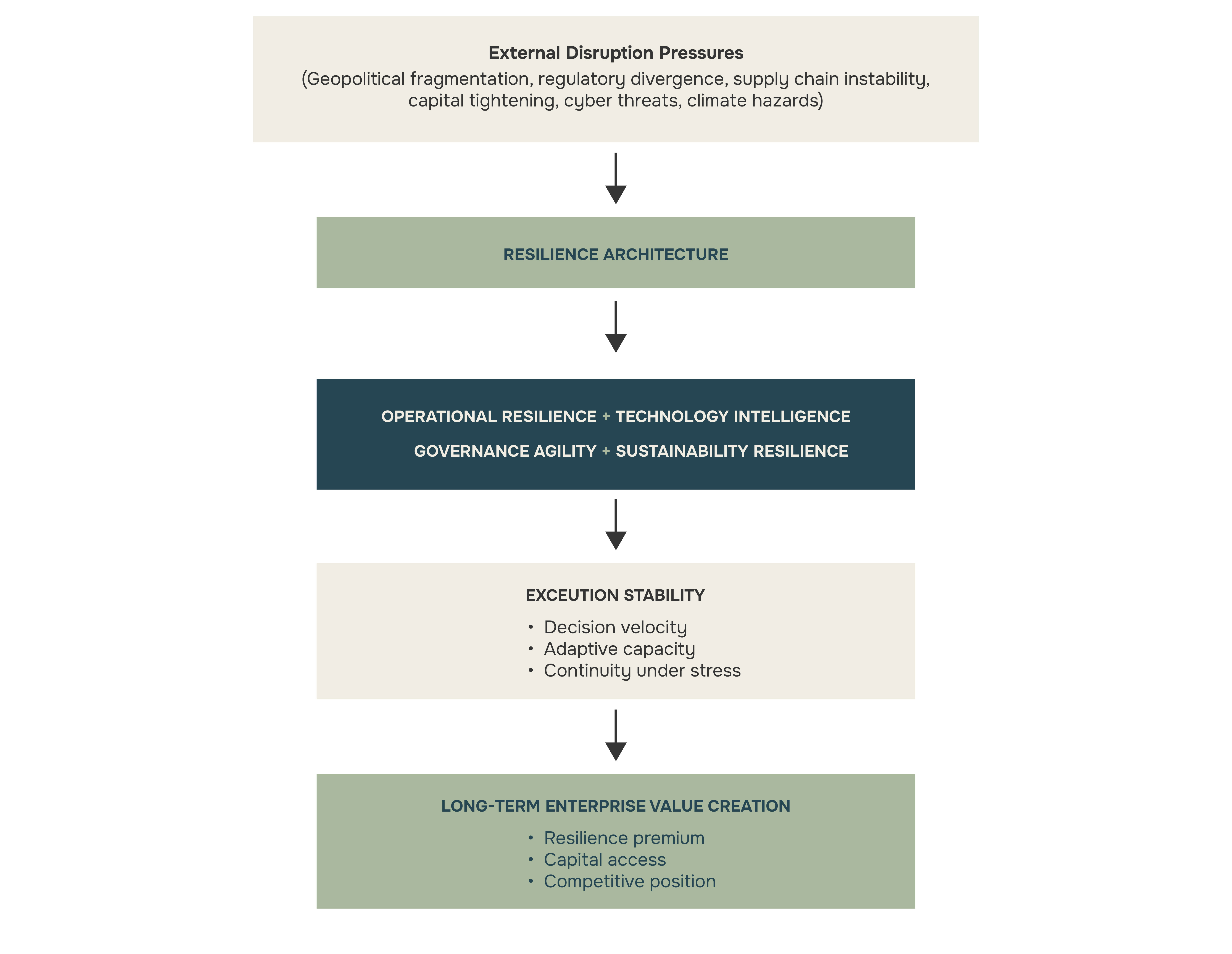
Resilience is not defensive posture. It is strategic infrastructure that determines whether organizations execute through disruption or become paralyzed by it. The companies capturing market leadership design resilience across four integrated dimensions.
Pillar 1: Operational Resilience
Resilience must be designed, not improvised. This means moving beyond business continuity plans that sit in binders toward operational capabilities that function under stress. Distributed operations reduce single-point dependencies. Supply chain diversification segments geopolitical exposure. Scenario planning becomes routine discipline, not annual exercise. Business continuity integrates into daily operations rather than existing as separate protocol activated only during crisis.
The World Economic Forum's framework for climate resilience provides transferable principles: develop processes to map exposure at asset level, integrate site-specific continuity and crisis management planning, and build partner ecosystems that understand shared risk (WEF, 2024). These capabilities apply beyond climate, they represent operational intelligence that enables rapid response regardless of disruption source.
Organizations with operational resilience think probabilistically about risk. Instead of assuming supply chains remain stable, they design for intermittent instability. Instead of expecting regulatory environments to hold steady, they build compliance flexibility. Instead of planning as if access to capital, talent, and markets remains constant, they architect operations that function when those assumptions break. This is not pessimism, it is operational realism in a fragmented world.
Pillar 2: Technology Intelligence
Technology should improve adaptability, not increase complexity. AI-enabled decision systems, predictive analytics, and integrated enterprise data create value when they reduce decision latency and surface operational insights faster than disruption compounds. The digital vanguard, organizations achieving 71 percent success rates in digital initiatives versus 48 percent industry average, use technology to enable execution velocity, not just operational visibility (Gartner, 2025).
Technology intelligence means deploying systems that answer three questions faster than competitors: What is changing in our operating environment? What does that change mean for our operations? What actions do we need to take? Organizations achieving this capability embed real-time monitoring across supply chains, integrate predictive models that flag emerging risks, and build automated response protocols that execute predefined actions when thresholds breach.
McKinsey research emphasizes that most IT leaders now face challenges extending beyond 2024 into 2025 and beyond, including AI strategy formalization, talent development, cybersecurity readiness, and data governance (McKinsey, 2025). Organizations treating these as separate initiatives miss the integration opportunity, AI strategy should enhance resilience, talent strategy should build adaptive capacity, cybersecurity should enable rather than constrain operations, and data governance should accelerate rather than slow decision-making.
Pillar 3: Governance Agility
The speed of decision-making is becoming a competitive metric. Organizations that can assess changing conditions, evaluate response options, and execute decisions within days rather than quarters capture advantages that efficiency alone cannot deliver. Governance agility requires three structural changes.
First, decision authority must move from approval hierarchies to execution teams. Cross-functional units with clear accountability and pre-authorized decision rights can respond to operational realities without escalating every material choice to executive committees. This does not mean eliminating oversight, it means embedding oversight into operational cadences rather than separating it as approval gates that slow response.
Second, performance visibility must be real-time, not quarterly. Traditional reporting cycles create information lag that makes rapid adaptation impossible. Organizations achieving governance agility build dashboards that surface operational metrics daily, flag emerging risks automatically, and trigger review protocols when performance deviates from expected ranges. This creates governance rhythm matched to the speed at which operating reality changes.
Third, accountability architecture must be clear and consequences must be consistent. When decision rights are ambiguous, organizations default to consensus-seeking that delays action. When accountability is vague, execution discipline erodes. The highest-performing organizations document precisely which roles own which decisions, what authority boundaries exist, and how escalation works when complexity exceeds defined thresholds.
Pillar 4: Sustainable Resilience
Sustainability is economic durability, not compliance checkbox. Energy resilience determines whether operations continue when primary power sources become constrained or expensive. Sustainability-linked operations create regulatory readiness as carbon pricing, emission limits, and transition mandates proliferate. Long-term resource stability protects margins when commodity volatility increases and supply chains fragment.
Organizations embedding sustainability into resilience architecture gain multiple advantages. They access lower-cost capital as ESG-linked financing expands. They avoid stranded assets as regulatory environments shift toward decarbonization. They build stakeholder confidence that supports license to operate. They develop operational muscle memory for adapting to environmental constraints that competitors treat as future problems.
The transition to green fuels and hydrogen highlights how sustainability intersects with supply chain resilience (WEF, 2024). Securing critical technologies, zero-carbon hydrogen, biofuels, carbon electrodes, requires careful management of land, water, and logistics resources. Organizations treating sustainability as separate from resilience strategy discover that transition risks materialize faster than adaptation capacity develops.
Enterprise Resilience Architecture Framework
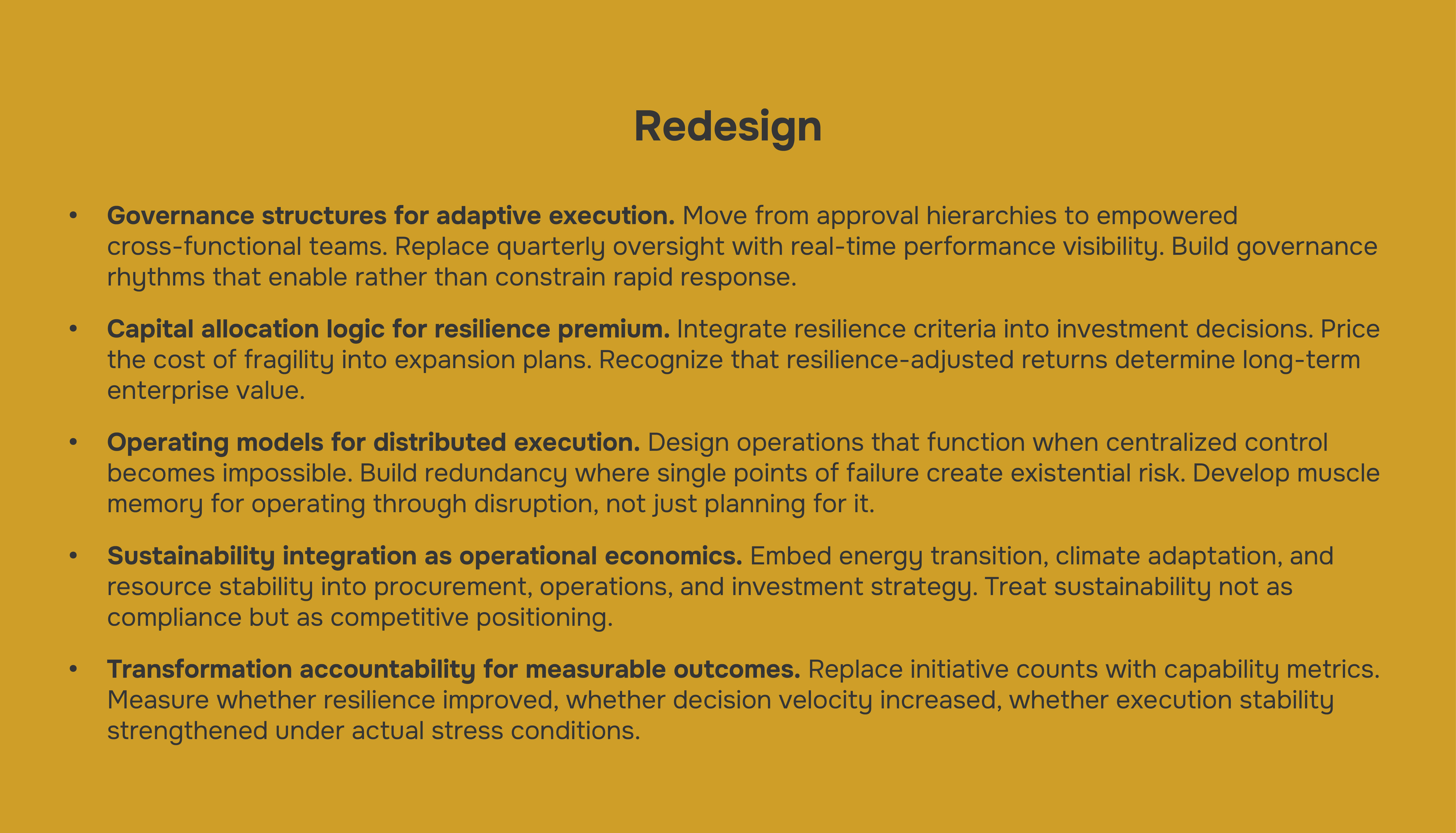
What Organizations Must Redesign Now
Analysis without action creates illusion of progress while competitive positioning erodes. The organizations winning through fragmentation are making structural changes that others discuss but defer.
How Pacepoint Builds Strategic Resilience with Organizations
Most advisory firms produce resilience assessments, risk frameworks, and transformation roadmaps, then depart before implementation begins. Pacepoint takes a fundamentally different approach. We do not assess resilience; we build it.
We architect operating models for distributed execution. Working directly with CEOs, COOs, and business unit leaders, we redesign how organizations make decisions, allocate resources, and execute under uncertainty. This means mapping decision authority across functions, documenting escalation protocols, and building governance cadences that enable rapid response without executive bottlenecks. We create decision rights matrices that operationalize immediately, not frameworks that remain theoretical.
We design technology architectures for adaptive capacity. Collaborating with CIOs and technology leaders, we determine which systems actually improve resilience versus which add complexity. We integrate predictive analytics into operational workflows, build real-time monitoring that surfaces emerging risks, and establish automated response protocols that execute when thresholds breach. Technology becomes resilience infrastructure, not cost center.
We build measurement frameworks that prove resilience works. Working with CFOs and finance teams, we establish metrics that distinguish operational stability from fragility, decision velocity from decision latency, and adaptive capacity from reactive scrambling. We design quarterly resilience reviews where boards evaluate whether the organization's ability to execute through disruption improved, not whether resilience initiatives launched.
We embed with leadership teams through execution, not just design. Our engagement model assumes that resilience capability develops through implementation discipline, not strategy documents. We stay engaged as organizations execute: running scenario simulations with executive teams, stress-testing response protocols under realistic conditions, and building the muscle memory that distinguishes organizations that survive disruption from those that thrive through it.
We integrate sustainability as economic durability. We work with sustainability officers, operations leaders, and strategy teams to connect climate adaptation, energy transition, and resource stability with operational resilience and competitive positioning. This means embedding sustainability criteria into capital allocation, redesigning supply chains for resource stability, and building regulatory readiness into governance processes. Sustainability becomes operational advantage, not compliance burden.
What differentiates Pacepoint: we measure success when organizations demonstrate improved execution under actual stress, when supply chain disruptions no longer paralyze operations, when geopolitical shifts trigger rapid strategic pivots rather than extended executive debates, when technology enables faster adaptation rather than creating coordination complexity. We stay engaged until resilience becomes organizational capability, not initiative.
The organizations that will capture market leadership over the next decade are not those with the largest balance sheets or the most ambitious strategies. They are those that built resilience architecture enabling them to execute while competitors hesitate, adapt while others plan, and deliver while fragmentation creates paralysis.
Resilience is not about surviving disruption. It is about turning volatility into competitive advantage through superior execution under uncertainty.
Key Takeaways
The Global Operating Model Has Structurally Changed: Uncertainty has nearly doubled since the 1990s. US-China tariffs increased sixfold since 2017. Global trade interventions grew twelvefold since 2010. This is not temporary volatility, it is permanent fragmentation.
Traditional Efficiency Models Create Fragility: Organizations optimized for cost reduction lack adaptive capacity. McKinsey simulations show automotive companies face 40-60% enterprise value reductions under trade disruption scenarios.
Resilience Is Economic Strategy, Not Risk Management: Fortune 500 earnings call mentions of "resilience" surged 200% compared to 2019 (WEF, 2025). Boards now demand resilience-adjusted performance, not just growth.
Four Pillars Define Enterprise Resilience: Operational resilience (distributed execution, scenario planning), Technology intelligence (predictive analytics, decision velocity), Governance agility (decision authority, real-time visibility), and Sustainable resilience (energy stability, regulatory readiness).
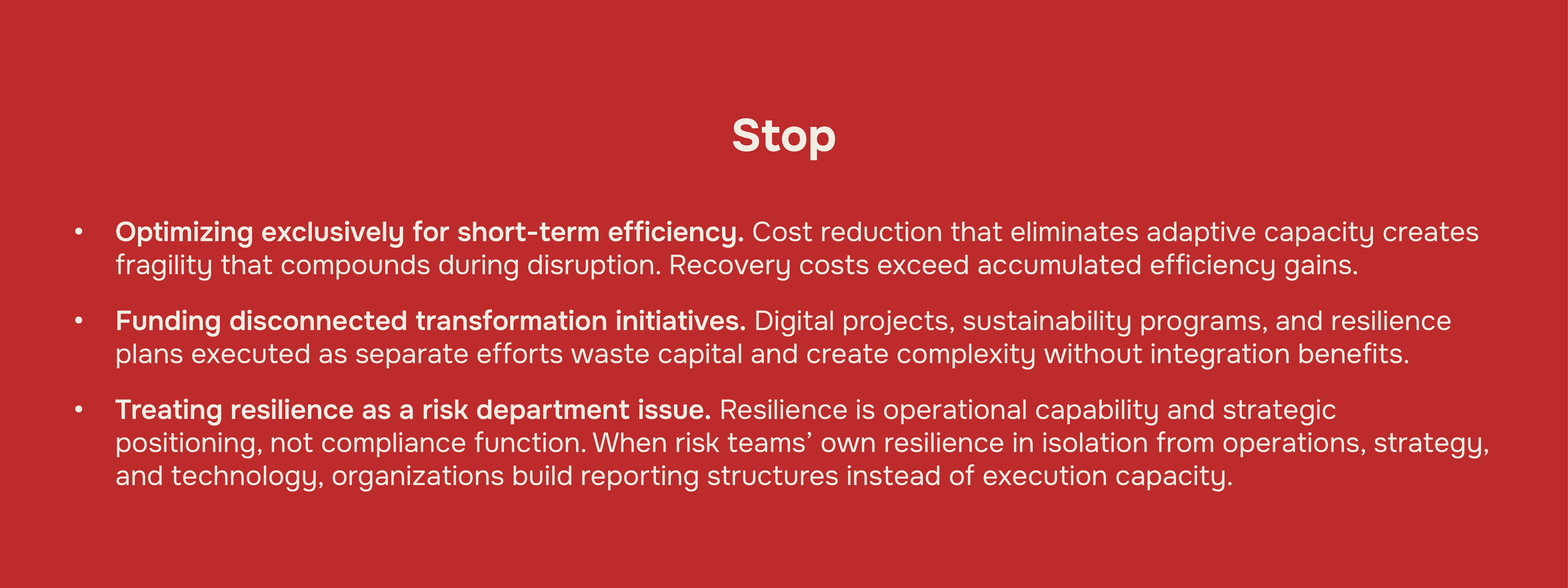
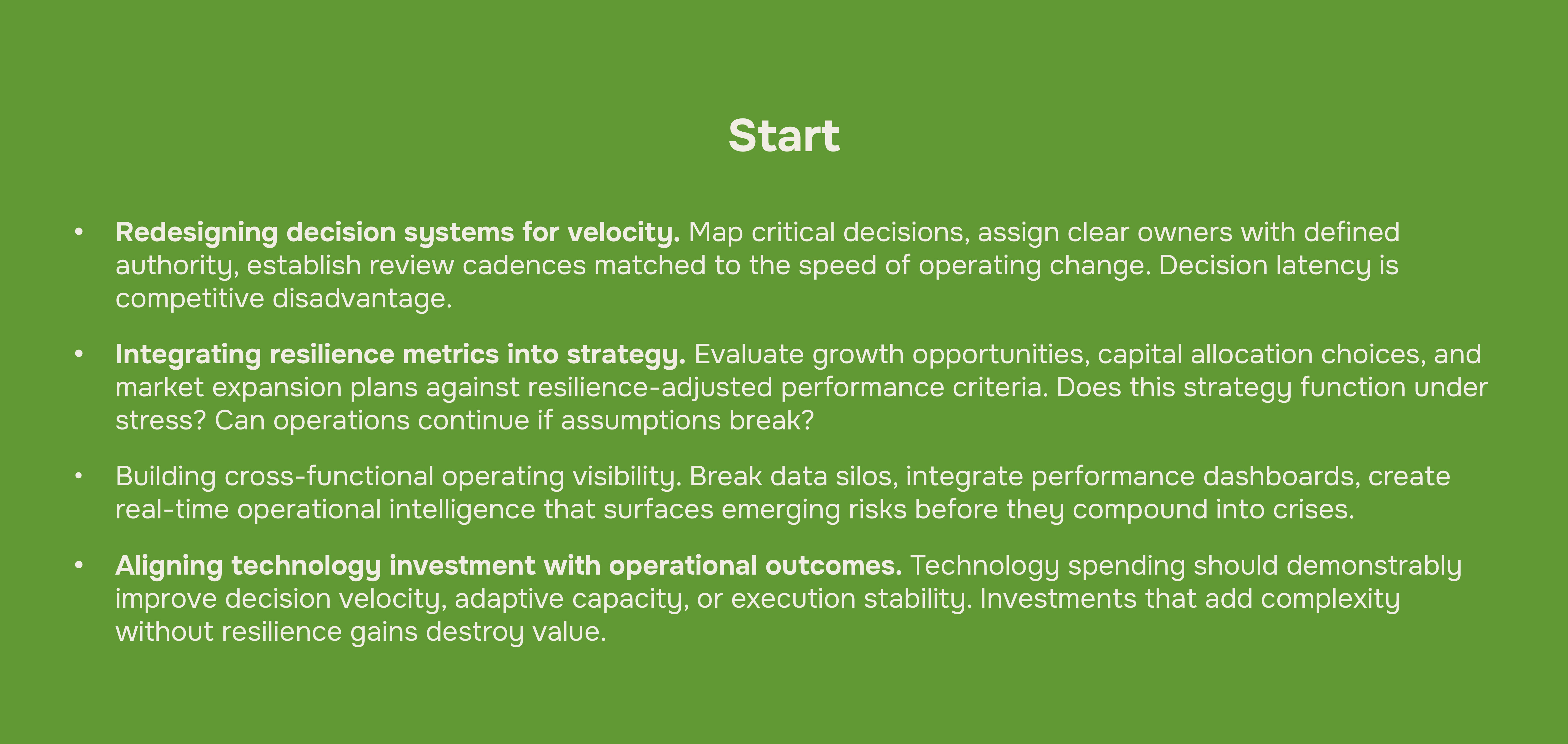
Organizations Must Redesign, Not Optimize: Stop funding disconnected initiatives. Start integrating resilience into strategy and capital allocation. Redesign governance for velocity, operating models for distribution, and sustainability as economics.
References
- Gartner. (2025). Priorities CIOs must address in 2025: Insights from the 2025 Gartner CIO Survey. Retrieved from https://www.gartner.com/en/articles/priorities-cios-must-address-in-2025-according-to-gartner-s-cio-survey
- International Monetary Fund. (2023, April). Global financial stability report: Safeguarding financial stability amid high inflation and geopolitical risks. Retrieved from https://www.imf.org/en/Publications/GFSR
- McKinsey & Company. (2023, November 10). How to develop geopolitical resilience. Retrieved from https://www.mckinsey.com/capabilities/strategy-and-corporate-finance/our-insights/how-to-develop-geopolitical-resilience
- McKinsey & Company. (2024, May 17). How your company can build geopolitical resilience. Retrieved from https://www.mckinsey.de/capabilities/strategy-and-corporate-finance/our-insights/can-your-company-remain-global-and-if-so-how
- McKinsey & Company. (2025, September 3). How to create strategic resilience in uncertain times. Retrieved from https://www.mckinsey.com/industries/technology-media-and-telecommunications/our-insights/winning-through-the-turns-how-smart-companies-can-thrive-amid-uncertainty
- McKinsey & Company. (2025, November 21). Leading amid geopolitical upheaval: Five imperatives for today's CEOs. Retrieved from https://www.mckinsey.com/capabilities/geopolitics/our-insights/leading-amid-geopolitical-upheaval-five-imperatives-for-todays-ceos
- McKinsey & Company. (2026, February 20). What leaders need to know about building tech resilience amid geopolitical risk. Retrieved from https://www.mckinsey.com/about-us/new-at-mckinsey-blog/what-leaders-need-to-know-about-building-tech-resilience-amid-geopolitical-risk
- McKinsey Global Institute. (2024, January 17). Geopolitics and the geometry of global trade. Retrieved from https://www.mckinsey.com/mgi/our-research/geopolitics-and-the-geometry-of-global-trade
- World Economic Forum. (2024, January 10). How to build business resilience in an era of global risks. Retrieved from https://www.weforum.org/stories/2024/01/global-risks-2024-business-resilience-in-an-era-of-risk-turbulence/
- World Economic Forum. (2024, December 11). 10 ways businesses can build resilience to climate hazards. Retrieved from https://www.weforum.org/stories/2024/12/ways-business-leaders-build-resilience-climate-hazards/
- World Economic Forum. (2025, January 21). Public-private collaboration key to building resilience. Retrieved from https://www.weforum.org/stories/2025/01/public-private-collaboration-building-resilience/
- World Economic Forum. (2025). Resilience pulse check: Harnessing collaboration to navigate a volatile world. Retrieved from https://reports.weforum.org/docs/WEF_Resilience_Pulse_Check_2025.pdf
- World Economic Forum. (2026, January 15). Global Lighthouse Network: Rewiring operations for resilience and impact at scale. Retrieved from https://www.weforum.org/publications/global-lighthouse-network-rewiring-operations-for-resilience-and-impact-at-scale/