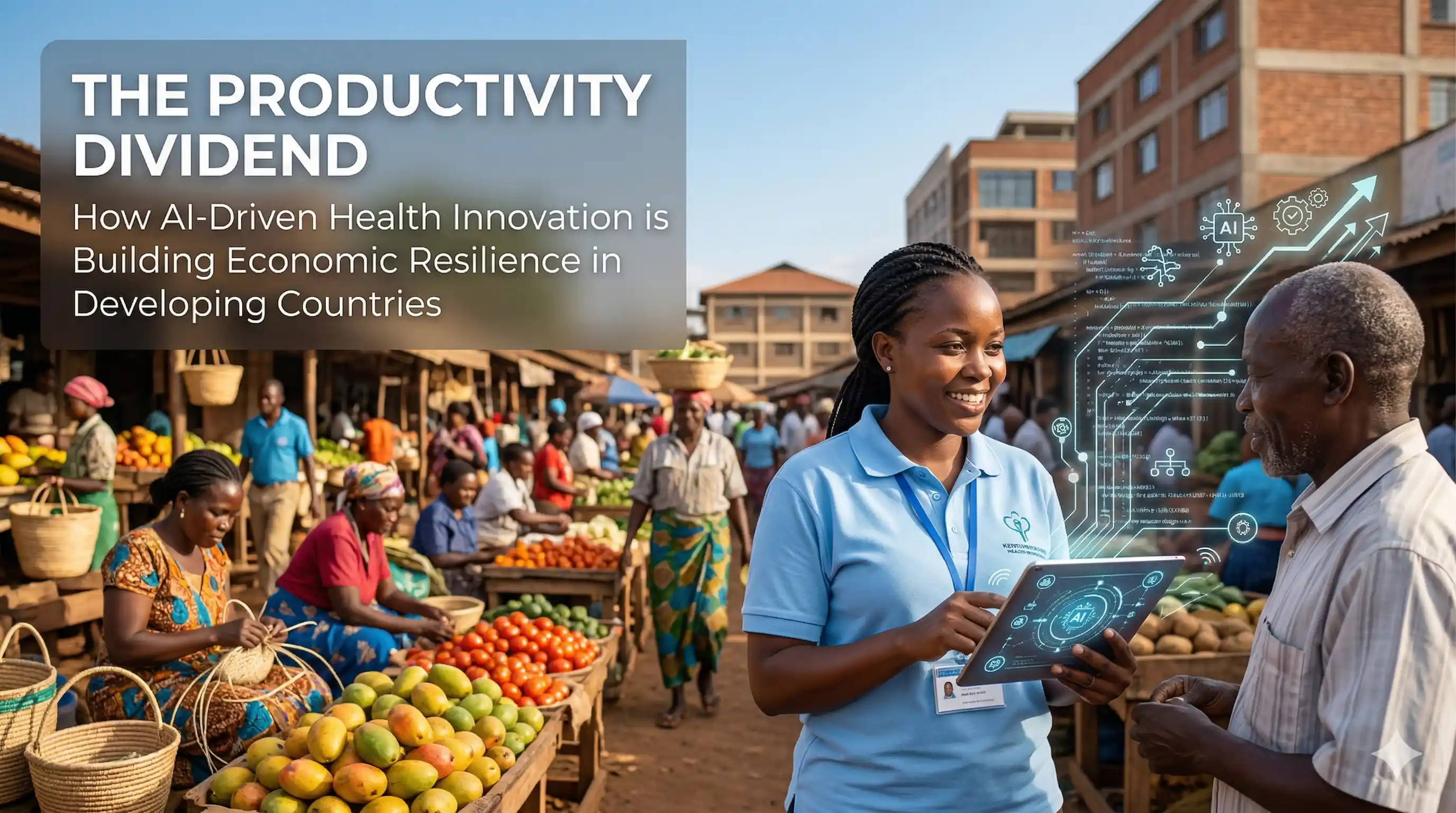

"A country cannot build a competitive economy on a sick workforce. And it cannot build a healthy workforce without a healthcare system that works. AI is now making both possible, simultaneously, and at a scale previously unimaginable."
Consider this: every day a worker in Lagos, Nairobi, or Dhaka misses work due to a preventable illness, an undiagnosed condition, or inadequate treatment is not just a personal tragedy, it is an economic loss. Multiply that across millions of workers, in dozens of countries, over decades, and you begin to understand why health system performance is not merely a social policy question. It is one of the most consequential determinants of a nation's economic trajectory.
Developing country governments have long understood this connection in theory. The challenge has always been practical, how do you build a healthcare system capable of delivering quality, accessible, affordable care at national scale, when you are simultaneously managing constrained fiscal space, workforce shortages, infrastructure deficits, and the persistent shocks of pandemics, climate events, and economic volatility?
Artificial intelligence is not a silver bullet. But the evidence increasingly shows that, deployed thoughtfully and governed responsibly, AI-driven health innovation is one of the most powerful tools available to developing country governments seeking to break the cycle between poor health and poor economic performance. This blog makes that case, with data, with examples, and with the honest acknowledgment of what still needs to go right.
Why This Matters More Than Ever
The relationship between population health and economic productivity is not new. What is new is the precision with which we can now quantify it and the urgency with which developing country governments must act on that evidence.
The World Health Organization estimates that low- and middle-income countries lose between 6 and 12 percent of GDP annually to the economic consequences of poor health through lost labour productivity, catastrophic household health expenditure that pushes families into poverty, and the long-term human capital costs of childhood illness and malnutrition (WHO, 2021). In sub-Saharan Africa alone, the economic burden of communicable and non-communicable diseases combined is estimated to suppress GDP growth by 1.5–2.0 percentage points annually relative to what equivalent health outcomes in higher-income settings would deliver (World Economic Forum, 2025).
Against this backdrop, AI's potential to improve health system performance at scale is not an abstract technological aspiration. It is a concrete economic opportunity one that a growing number of governments in the Global South are beginning to seize, with measurable results.
Global AI in healthcare is projected to generate a USD 10.7 trillion economic impact by 2030. The question for developing country governments is not whether to engage with this transformation it is how to ensure their populations and economies are on the right side of it (MarkiTech, 2025; Scirp.org, 2025).
AI as an Economic Multiplier-The Evidence Base
The economic case for AI in healthcare is no longer speculative. A growing body of evidence from 2024 to 2026 spanning major economies and, increasingly, emerging market quantifies the GDP contributions, cost savings, and productivity gains that AI-driven health innovations are generating.
GDP Contributions and Sectoral Growth
India provides perhaps the most compelling emerging-market case study. AI in healthcare is projected to contribute USD 25–30 billion to India's GDP by 2025, driven by enhanced diagnostic accessibility, MedTech expansion, and the scaling of AI-powered telemedicine platforms to Tier-II and Tier-III cities and rural areas that were previously beyond the reach of specialist care (Ghosh, 2025; The Indian Practitioner, 2025). This is not growth confined to the healthcare sector it cascades into workforce productivity, reduced catastrophic health expenditure for households, and the development of a domestic health technology industry with export potential.
In the United States where the evidence base is more mature, AI applications in healthcare are forecast to generate USD 150 billion in annual savings by 2026, through robot-assisted surgery, virtual nursing, AI-assisted diagnostics, and administrative automation. Modelling by economists translates this into a 2-4% GDP uplift via efficiency gains and a projected 21% net rise in U.S. GDP attributable to AI across sectors by 2030 (Deloitte, 2025; MarkiTech, 2025). While the absolute dollar figures differ dramatically between the U.S. and developing country contexts, the proportional efficiency gains and the underlying mechanisms that produce them are directly applicable and arguably more impactful in resource-constrained environments where baseline inefficiency is higher.
Gondauri (2023) demonstrated through cross-national analysis that AI patent intensity per capita a proxy for AI adoption depth correlates with 0.3% GDP gains, with the strongest effects concentrated in high-tech services sectors. For developing country governments investing in domestic AI health technology capacity, this correlation suggests a compounding economic return: health system improvements generate workforce productivity gains, which in turn support the tax base and domestic innovation ecosystem required to sustain further AI investment.
Cost-Benefit Dynamics
Understanding where AI generates economic returns in health systems is essential for governments designing investment strategies. The evidence identifies four primary value creation mechanisms:
AI as a Shock Absorber
Economic resilience the capacity of an economy to absorb shocks and recover is not separable from health system resilience. COVID-19 demonstrated this with brutal clarity: countries whose health systems collapsed under pandemic pressure suffered not only mass mortality but economic contractions that erased years of development gains. AI is now a central pillar of both health and economic resilience strategy for forward-looking governments.
Supply Chain Optimisation and Pandemic Preparedness: One of the most economically costly failures of the COVID-19 response in developing countries was supply chain collapse: stockouts of essential medicines, oxygen, and personal protective equipment at precisely the moments of greatest clinical need. AI-powered supply chain systems using predictive demand modelling, real-time inventory tracking, and automated procurement triggers are now being deployed by several African governments to prevent recurrence.
Rwanda's AI Health Intelligence Centre, established through a public-private partnership model, exemplifies this approach. By integrating AI-driven disease surveillance, diagnostic support, and supply chain management into a single national health intelligence platform, Rwanda has created a system capable of detecting and responding to health threats before they escalate into crises — unlocking domestic and international funding flows that were previously inaccessible without demonstrated system capacity (Sands, 2026; World Economic Forum, 2025).
Telemedicine and the Absenteeism Economy: The indirect economic costs of poor healthcare access in developing countries are systematically underestimated. When a worker in a peri-urban area must travel four hours round-trip to access a clinic, take a full day off work for a consultation that takes twenty minutes, and repeat that journey multiple times for follow-up care, the economic cost in lost wages, lost productivity, and transport expenditure dwarfs the direct cost of the healthcare itself. AI-enabled telemedicine platforms eliminate most of these indirect costs.
Evidence from multiple developing country deployments demonstrates that telemedicine and AI-powered remote monitoring reduce indirect health-related costs including travel expenses, work absenteeism, and caregiver time by 20–30% per patient episode (Keysight Technologies, 2024; Rao, 2025). At population scale, this represents a substantial economic dividend: in Nigeria, where the formal and informal workforce combined numbers over 80 million, even a 5% reduction in health-related absenteeism generates productivity gains equivalent to billions of naira annually.
Drug Discovery and Personalised Medicine: AI is dramatically accelerating drug discovery timelines compressing processes that historically took 10–15 years and cost upwards of USD 2.6 billion per approved compound into timelines of 3–5 years at significantly reduced cost. For developing country governments, this has two distinct strategic implications.
First, diseases disproportionately affecting developing country populations including malaria, tuberculosis, neglected tropical diseases, and sickle cell disease have historically attracted insufficient pharmaceutical industry investment because their market size did not justify the development cost. AI is changing this calculus: by reducing discovery and development costs, it makes previously unviable therapeutic pathways economically feasible (Moro-Visconti et al., 2025; World Economic Forum, 2025). Second, AI-powered personalised medicine tailoring treatment protocols to individual patient genetic profiles, comorbidities, and treatment histories reduces the economic costs of treatment failure, adverse drug reactions, and the chronic disease management cycles that consume the largest share of health system budgets in middle-income countries.
Country-Level Lessons: What Governments Are Getting Right
The difference between AI health initiatives that deliver sustained economic returns and those that generate impressive pilot results before stalling is, in most cases, not the technology. It is the governance architecture surrounding the technology. Several developing country governments are demonstrating what getting this right looks like in practice.
Peter Sands of the World Economic Forum identifies three principles that distinguish scalable digital health initiatives from failed pilots: national policy alignment that embeds AI health tools within existing health system governance; data infrastructure investment that precedes AI deployment rather than following it; and financing models that spread the investment cost across government, private sector, and multilateral partners rather than relying on sovereign health budgets alone (Sands, 2026). These principles are not aspirational, they are observable characteristics of the initiatives generating measurable economic returns.
The Strategic Imperatives that Governments must do now
The economic opportunity is real. The evidence is robust. But the gap between potential and realised benefit is not closed automatically it requires deliberate, coordinated government action across several dimensions.
Build the Foundations Before the Applications: The single most common failure mode in developing country AI health initiatives is deploying AI applications onto inadequate data infrastructure. AI systems are only as good as the data they learn from and in health systems where patient records are paper-based, disease surveillance data is incomplete, and laboratory results are not digitally integrated, even sophisticated AI tools will underperform.
Governments must prioritise: national health data governance frameworks that define data standards, interoperability requirements, and patient privacy protections; digital health record infrastructure that creates the data substrate AI systems require; and the cybersecurity architecture to protect health data at national scale. These investments are not glamorous they do not generate headlines in the way that AI diagnostic tools do but they are the foundations on which sustainable AI health economies are built (Deloitte, 2025; Sands, 2026).
Demand Equity, Not Just Efficiency: AI health tools trained on non-representative data reproduce and amplify existing health inequities delivering worse performance for the populations that most need accurate diagnosis and treatment. Governments must make demographic equity a procurement requirement, not an afterthought: AI tools deployed in national health systems should be required to demonstrate equivalent performance across gender, age, ethnicity, and geographic subgroups before receiving regulatory approval (Moro-Visconti et al., 2025; Rao, 2025).
This is not just an ethical imperative it is an economic one. Health inequities are expensive: they generate higher rates of preventable hospitalisation, higher burden of late-stage disease presentations, and higher catastrophic expenditure among the households least able to absorb it. AI that reduces health inequity generates economic returns that AI serving only well-resourced populations does not.
Govern the Human-AI Interface: The most economically damaging AI health failures occur not when AI tools malfunction in isolation but when clinical professionals accept AI outputs uncritically, without the training or governance frameworks to identify errors and apply independent judgment. Developing country governments investing in AI health tools must invest equally in the professional development and regulatory standards that ensure those tools are used safely (Moro-Visconti et al., 2025).
Deloitte's 2026 health outlook identifies agentic AI systems capable of executing multi-step clinical and operational tasks autonomously as the next frontier of health system transformation. The economic returns from agentic AI in health operations modernisation are substantial, but they are contingent on governance frameworks that maintain human oversight, define accountability for AI-informed decisions, and create the audit infrastructure needed to detect and correct system failures before they scale (Deloitte, 2025).
The governments that will capture the full economic dividend of AI-driven health innovation are not those that move fastest to deploy AI tools. They are those that build the governance architecture data infrastructure, equity standards, professional training, and regulatory capacity within which AI tools can deliver their potential safely, sustainably, and at scale.
Vulnerability to Competitive Advantage
The trajectory of AI in healthcare points toward a USD 10 trillion-plus global economic impact by 2030 but the distribution of that impact is not predetermined. Current projections suggest that 70% of AI healthcare market value will be captured by North America and China, leaving developing country economies competing for the remaining 30% (MarkiTech, 2025; Scirp.org, 2025). This concentration is not inevitable it reflects current first-mover advantages that can be disrupted by deliberate government policy.
The developing countries that are moving decisively Rwanda, India, Kenya, and increasingly Nigeria are demonstrating that the barriers to AI health economic benefit are not primarily technological. They are political, institutional, and infrastructural. Governments that invest now in the data foundations, regulatory frameworks, and human capital required to deploy AI health tools responsibly will not merely improve their health systems they will create the conditions for domestic AI health technology industries capable of serving not just their own populations but the wider regional markets that share their epidemiological profiles, language contexts, and socioeconomic realities.
The health-economy nexus has always been real. AI is making it actionable at a speed and scale that was not previously possible. The governments that understand this and act on it with the seriousness it deserves will be looking back in a decade at this moment as the inflection point at which they chose to convert a structural vulnerability into a strategic competitive advantage.
AI does not merely help governments manage sick populations more efficiently. Deployed at scale and governed responsibly, it helps governments build the healthier, more productive, more economically resilient societies that sustained development requires.
References
- Deloitte. (2025, December 10). 2026 US health care outlook. https://www.deloitte.com/us/en/insights/industry/health-care/life-sciences-and-health-care-industry-outlooks/2026-us-health-care
- El Arab, R. A., et al. (2025). Systematic review of cost effectiveness and budget impact of AI in healthcare. npj Digital Medicine. https://www.nature.com/articles/s41746-025-01722-y
- Ghosh, J. (2025, February 28). AI in healthcare likely to contribute Rs. 2,61,990 crore (US$30 billion) to India's GDP by 2025. India Brand Equity Foundation. https://www.ibef.org/news/ai-in-healthcare-likely-to-contribute-rs-2-61-990-crore-us-30-billion-to-india-s-gdp-by-2025-report
- Gondauri, D. (2023). The impact of artificial intelligence on gross domestic product. International Journal of Innovative Science and Research Technology. https://www.ijisrt.com/assets/upload/files/IJISRT23APR1794.pdf
- Keysight Technologies. (2024, April 3). 3 ways that artificial intelligence is enabling resilience in healthcare. CSRWire. https://csrwire.com/press-release/3-ways-artificial-intelligence-enabling-resilience-healthcare/
- MarkiTech. (2025, February 4). AI in healthcare driving economic change in 2025. https://markitech.ca/blog/ai-in-healthcare-driving-economic-change-in-2025/
- Moro-Visconti, R., et al. (2025). Economic, ethical, and regulatory dimensions of artificial intelligence in healthcare. Frontiers in Public Health. https://www.frontiersin.org/articles/10.3389/fpubh.2025.1617138/full
- Rao, S. K. (2025). The impact of artificial intelligence on financial systems. PMC. https://pmc.ncbi.nlm.nih.gov/articles/PMC12273524/
- Sands, P. (2026, January 14). From pilots to scale: 3 principles for sustainable digital health. World Economic Forum. https://www.weforum.org/stories/2026/01/digital-healthcare-sustainable-resilient-ai/
- Scirp.org. (2025, October 27). AI's economic impact. https://www.scirp.org/journal/paperinformation?paperid=146696
- The Indian Practitioner. (2025, February 27). AI in healthcare to boost India's GDP by USD 25–30 billion. https://theindianpractitioner.com/ai-in-healthcare-to-boost-indias-gdp-by-usd-25-30-billion/
- The Indian Practitioner. (2026, January 1). AI and MedTech driving healthcare innovation 2026. https://theindianpractitioner.com/ai-and-medtech-driving-healthcare-innovation-2026/
- World Economic Forum. (2025, August 12). 7 ways AI is transforming healthcare. https://www.weforum.org/stories/2025/08/ai-transforming-global-health/
World Health Organization. (2021). Strengthening health systems resilience: Key concepts and strategies. WHO Press. https://www.who.int/